
EMA Clarifies Qualification Routes for Novel Drug-Development Methods
Revision 6 of EMA’s procedural guidance explains qualification advice, qualification opinions and evidence expectations for specific contexts of use. Its scope includes nonclinical NAMs alongside other methodologies used in medicinal-product development.
- Issuing Authority
- European Medicines Agency
- Jurisdiction
- European Union
- Document Covered
- Qualification of Novel Methodologies for Medicinal Product Development: Procedural Guidance to Applicants, EMA/CHMP/SAWP/72894/2008 Revision 6, adopted 15 June 2026.
A Voluntary Route for Broadly Usable Methods
The European Medicines Agency (EMA) adopted Revision 6 of its Qualification of Novel Methodologies procedural guidance on 15 June 2026. The document describes a voluntary route for obtaining scientific and regulatory assessment of methods used to generate evidence for medicinal products. Nonclinical approaches such as human-cell assays, microphysiological systems and computational methods are among the categories covered.
The route is intended for methodologies with general application and broad accessibility, including proprietary methods that can be made available to other developers. A product-specific application may instead be discussed through scientific advice. Methods used only for drug-candidate selection or individual treatment decisions fall outside the route when they do not directly support regulatory benefit–risk assessment. The guidance also distinguishes a methodology’s intended regulatory use from the technical device or software used to generate measurements; separate legal requirements can apply to those components.
Advice, Opinion and a Letter of Support
Qualification advice provides confidential, detailed recommendations on further evidence generation. EMA publishes agreed high-level information about the methodology, applicant and intended context of use. A promising method that needs further development may also receive a public Letter of Support, with the applicant’s agreement, to encourage collaboration and data sharing.
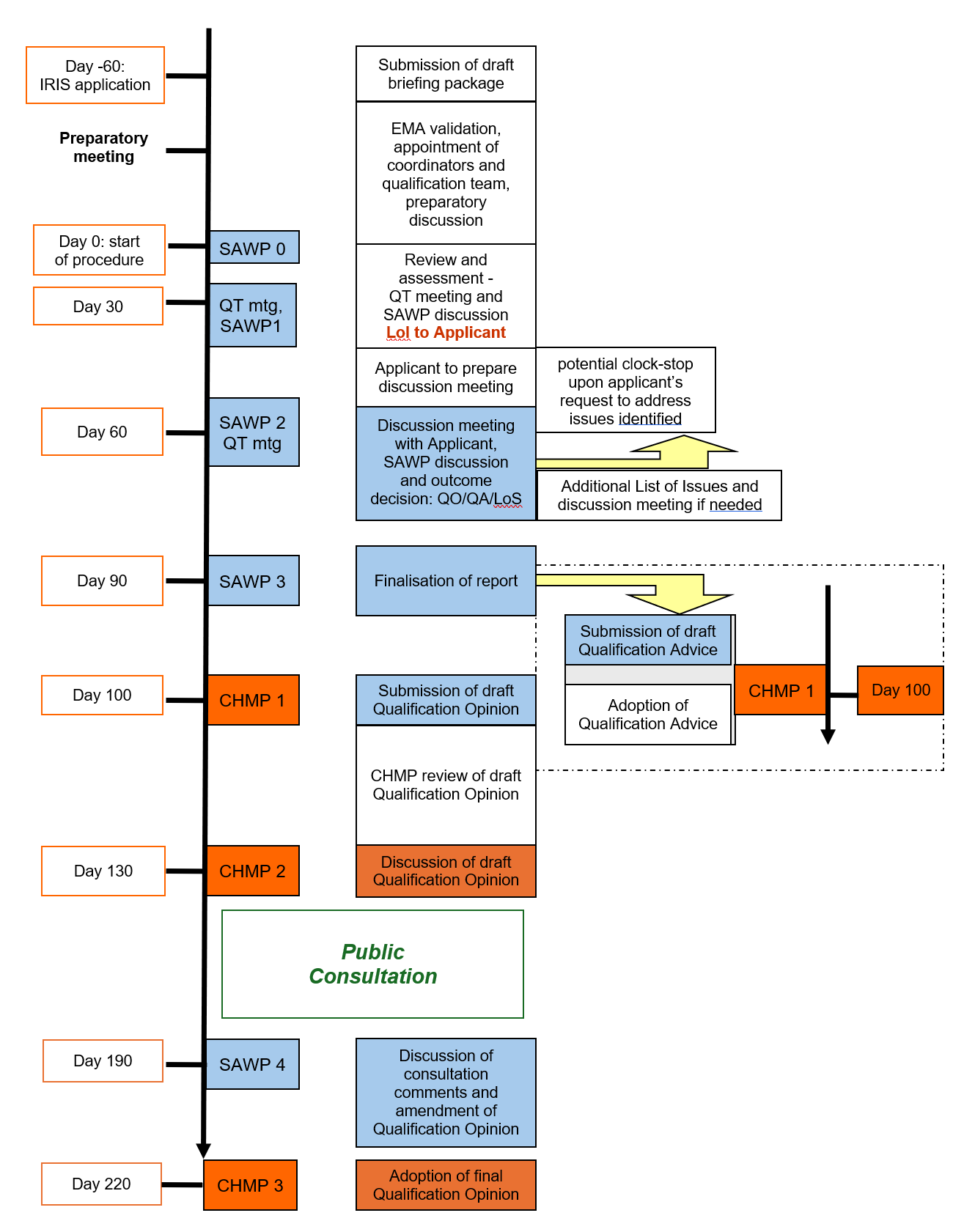
A qualification opinion assesses acceptability for a specified context of use. A draft opinion undergoes six weeks of public consultation before the Committee for Medicinal Products for Human Use (CHMP) considers the final version. Supporting evidence and performance information are published at an appropriate level of detail, with the treatment of proprietary information agreed between EMA and the applicant.
Prepare the Regulatory Question
EMA encourages early interaction to determine whether the methodology and proposed use fit the qualification route. Applicants should explain the scientific question, development stage, evidence already available and the plan for addressing remaining knowledge gaps. The Scientific Advice Office manages the procedure and a dedicated Qualification Team conducts the scientific assessment.
A context-of-use statement should describe the method’s role, population and disease setting, study context, inputs, outputs and relevant limitations. A narrow initial use can provide a clearer basis for evidence generation and later expansion. The regulatory role matters: a method intended to replace a confirmatory efficacy endpoint carries different evidence expectations from one used in exploratory work.
Separate Exploratory Development from Confirmation
The guidance favors prespecified qualification plans that distinguish exploratory learning from confirmatory validation. Feasibility work can inform the design, while independent testing is generally needed to confirm performance. Prospective validation is preferred and is required for some methodologies, including certain artificial-intelligence applications.
Developers should define evaluation criteria and metrics in advance and explain why they fit the intended question. The assessment considers technical performance, the overall methodology and the consequences of an incorrect decision. At submission, results should be compared with those criteria, with deviations from the plan and limitations explained.
Follow the Review and Consultation Process
The procedure includes a validated briefing package, independent coordinator reports, a List of Issues and discussion with the applicant. A request for an opinion can lead to qualification advice if the evidence does not yet support qualification. The guidance provides indicative milestones while allowing additional review time or clock stops for complex requests and further data generation.
The final opinion identifies the accepted context and the evidence supporting it. EMA can involve non-EU agencies as observers under appropriate arrangements, although the guidance describes no formal parallel qualification procedure with those agencies. Early coordination can help developers organize the evidence and discussions needed across regions.
Maintain Performance After Qualification
Lifecycle management is a substantive part of Revision 6. Applicants should propose plans for version control, monitoring, continued validation and communication of important changes. The guidance highlights evolving software, artificial-intelligence models and data sources, where performance can change with technology or population characteristics.
The monitoring plan is agreed case by case and included in the published opinion. Significant changes may require validation and a follow-up assessment; a different context of use requires a new qualification opinion. Developers using a qualified method in an application should demonstrate that its performance remains consistent with the published specifications and agreed lifecycle plan.