A Transfer Test Across Model Types
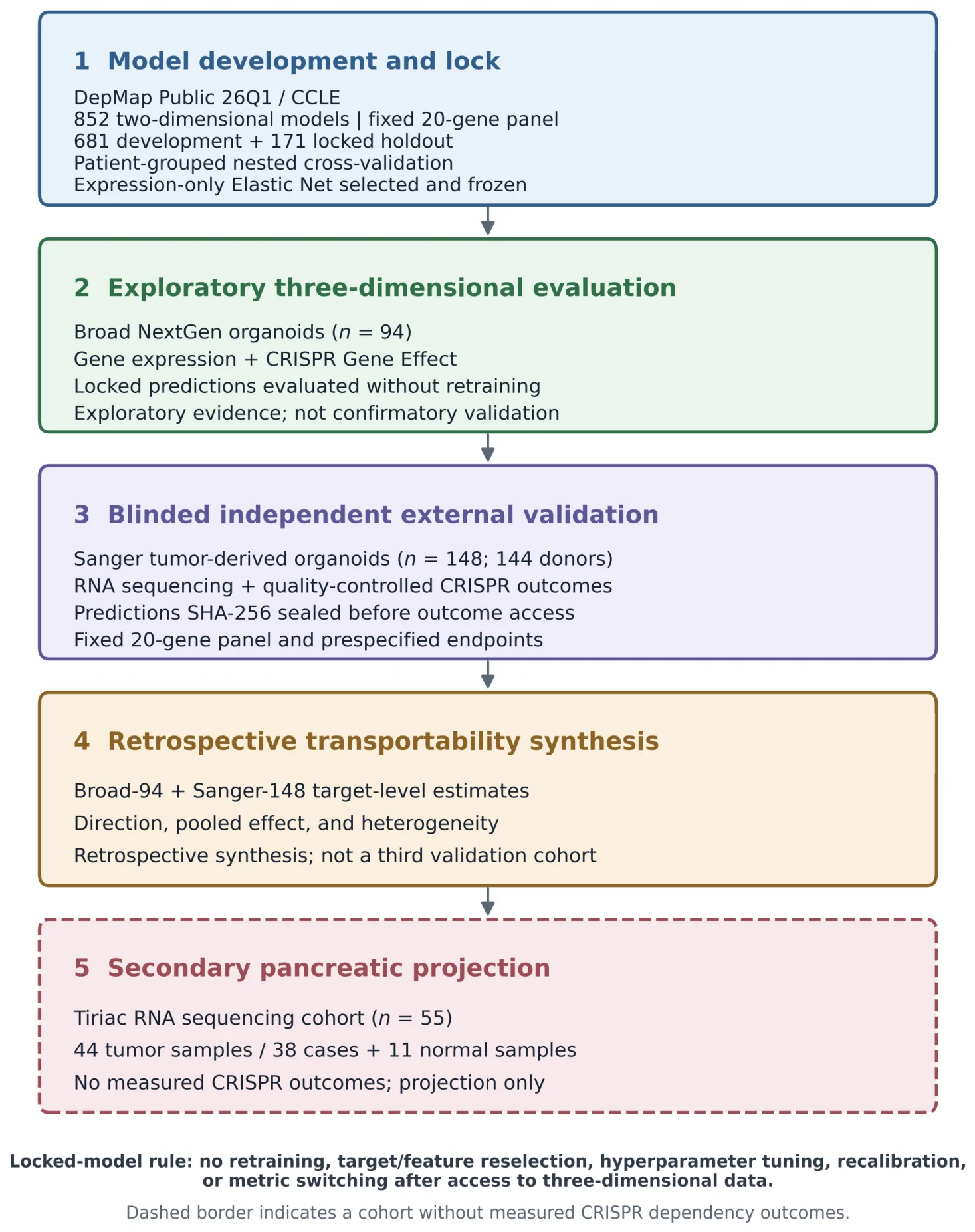
Researchers built expression-only Elastic Net models for 20 prespecified gene dependencies using conventional two-dimensional cancer models. They selected the model in 681 training models, checked it in a locked 171-model holdout, then assessed transfer to 94 Broad organoids and 148 Sanger organoids from 144 donors. Predictions for the Sanger set were sealed before the measured outcomes were accessed.
The mean target-wise Spearman correlation, ranking models by their dependency on each gene, was 0.4094 in the 2D holdout, 0.1518 in Broad organoids and 0.1015 in Sanger organoids. The 2D holdout was only a conditional internal check because historical selection of the 20 genes had used all 852 2D models.
What Was Kept Fixed Before the Organoid Test
The development comparison considered expression alone alongside candidates that added copy-number, mutation or lineage information. More input did not reliably improve the target-wise ranking, so the authors selected the simpler expression-only representation. After the locked holdout evaluation, the authors refitted the selected models on all 852 2D models before the organoid transfer tests, keeping the chosen representation, features and hyperparameters fixed. They were not retrained to improve their fit after the organoid outcomes were revealed.
The two organoid resources played different roles. Broad was an exploratory transfer set because it had been accessible during earlier methodological work. A later donor audit recovered information for only part of that collection and identified a shared-donor pair. Sanger was constructed as a separate blinded validation cohort after excluding Broad-linked models and an additional same-donor record. These design differences matter when comparing the precision of the two estimates.
A Signal, but Limited Added Value
In Sanger, the association exceeded a within-lineage permutation reference (p = 0.00040), while the estimated improvement over a lineage-only model was 0.0462 with a 95% confidence interval from −0.0065 to 0.0986. The interval spans zero. CDK6, MDM4 and CCNE1 passed false-discovery-rate correction in that cohort.
In the independent Sanger set, 17 of the 20 target-wise correlations were positive, but the average signal was small. The lineage-only comparison was especially relevant because expression can encode tumor origin. A statistically detectable association across the panel did not settle whether the molecular model added useful information beyond that origin.
A second question was examined retrospectively: within one organoid, could the predictions order the 20 genes by measured dependency? Mean correlations for that task were 0.3428 in Broad and 0.4294 in Sanger. These values use a different comparison axis from the primary target-wise correlations and should not be read as stronger versions of the same result. A fixed ranking based on average 2D dependency also performed positively, so the authors compared against that reference and against lineage-only predictions. Top-three overlap improved over the lineage reference only in Sanger, so better full-panel agreement did not consistently improve that short list.
A Prioritization Hypothesis for Direct Testing
The intended use is to help allocate limited capacity for direct organoid experiments, not to replace a perturbation assay with an expression score. Historical selection of the gene panel, incomplete donor information in Broad and the small number of targets restrict the result. The pancreatic-organoid projection is further removed from validation because it lacks measured dependency outcomes. A prospective test would need to determine whether a frozen ranking actually improves the yield of experimentally useful targets, rather than merely correlating with existing screening scores.