
ICH M15 Sets a Framework for Assessing Model-Informed Drug Evidence
The final guideline links model evaluation to a defined drug-development question and the consequences of an incorrect decision. It also organizes planning, reporting and the evidence submitted to regulators.
- Issuing Authority
- International Council for Harmonisation
- Jurisdiction
- ICH regions; regional implementation is separate
- Document Covered
- General Principles for Model-Informed Drug Development M15, final Step 4 guideline adopted 29 January 2026.
An Assessment Framework Across Modeling Methods
The International Council for Harmonisation (ICH) adopted the final M15 guideline, General Principles for Model-Informed Drug Development, on 29 January 2026. The guideline establishes a common framework for assessing evidence generated through computational modeling and simulation. At Step 4 of the ICH process, it is recommended for adoption by regulatory bodies in ICH regions.
The scope includes population pharmacokinetics and pharmacodynamics, physiologically based models, exposure–response analysis, quantitative systems pharmacology and toxicology, disease-progression models and artificial intelligence or machine learning, among other approaches. For NAMs, the framework is particularly relevant to computational methods and models integrating nonclinical and clinical evidence. It focuses on evidence assessment and communication rather than detailed instructions for building every model type.
Define the Question and the Role of the Model
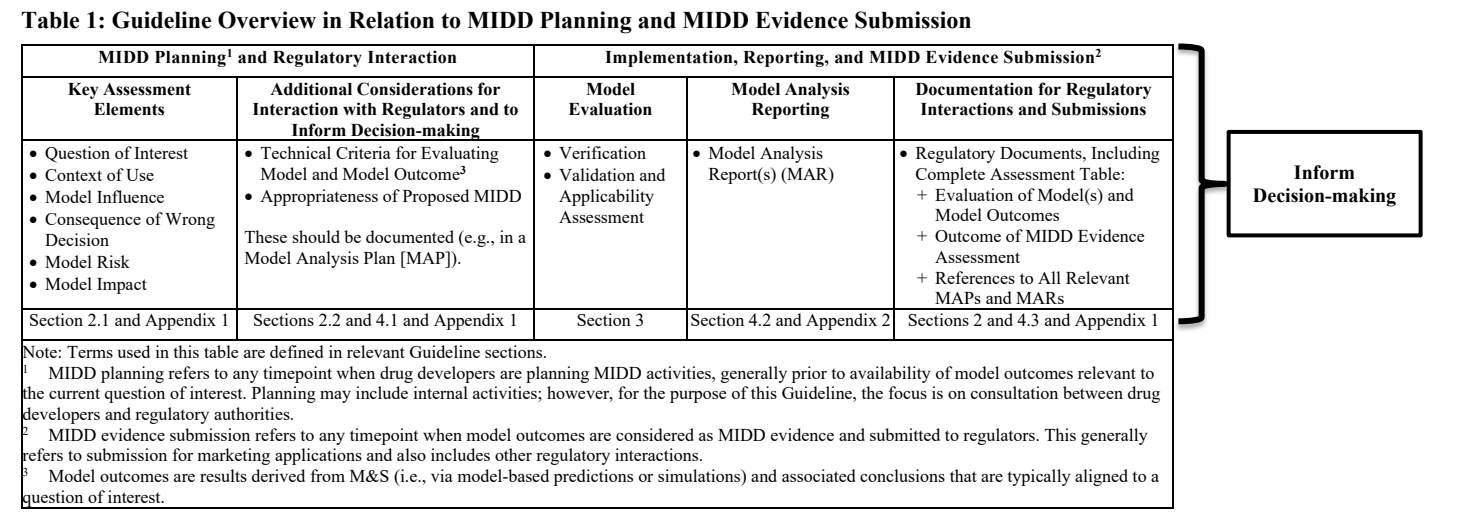
M15 begins with the question of interest: what information is needed for a drug-development or regulatory decision? The context of use then defines the model’s role and scope in answering that question, including the data used to construct it and other evidence contributing to the decision. Separate questions may require separate assessments.
The framework distinguishes model influence from the consequence of a wrong decision. Influence describes the intended weight of the model relative to other evidence. Consequence considers potential effects on safety or efficacy, accounting for their severity and likelihood. Combining the two informs a justified model-risk rating and the level of evaluation required.
A separate concept, model impact, describes how far the proposed strategy varies from regulatory standards or expectations. These elements support early discussion with regulators. Ratings are accompanied by reasoning so that multidisciplinary teams can understand the assumptions behind the proposed evidence strategy.
Evaluate Implementation, Performance and Applicability
Verification addresses the correctness of user-generated code, equations and calculations. Validation examines the model against observations, prior information and knowledge. Applicability assessment focuses on whether the data and model are adequate for the particular intended use. Together, these activities form the basis for judging whether model outcomes can support the question being asked.
The guideline calls for relevant data, justified selection and handling procedures, biologically appropriate model structures and parameters, and explicit assumptions. Evaluation should assess robustness to data, parameter and structural uncertainty. Graphical and numerical performance measures should prioritize the intended application. Independent external validation is encouraged and can be essential for some proposed uses.
Method-specific concerns also matter. M15 gives examples such as selection bias in model-based meta-analysis, knowledge gaps in mechanistic models and overfitting in machine learning. Technical criteria should be defined in advance and proportionate to model risk, with deviations from the planned analysis explained.
Plan the Analysis and Report the Results
A model analysis plan sets out objectives, data, methods and planned evaluation criteria. A model analysis report documents implementation, findings, model evaluation, interpretation and limitations. The report can follow a structure appropriate to the modeling method while preserving the information needed to assess the evidence.
M15’s assessment table connects these technical documents to the development question. At planning, it records the key assessment elements, proposed technical criteria and rationale for the strategy. At submission, it adds the results of evaluation and a multidisciplinary conclusion on whether the model outcomes constitute suitable evidence.
Keep the Evidence Traceable
The guideline recommends cross-referencing the assessment table, analysis plans, reports and other relevant regulatory documents. Data, code, definition files and supporting electronic materials should be submitted or available for review. As questions or knowledge change, the assessment can be updated and further regulatory discussion may be needed.
This approach gives computational evidence an explicit chain from question to model, evaluation and decision. Its central requirement is a clear scientific justification for the use being proposed, supported by documentation that allows reviewers to follow how the conclusions were reached.