Device Sorption Can Distort the Exposure Measurement
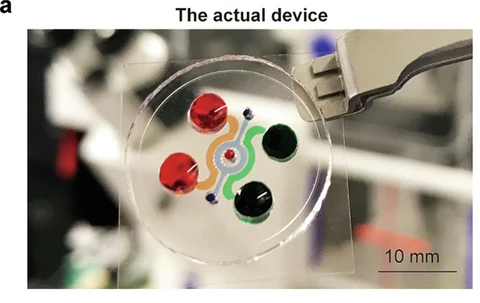
A gut–liver chip can follow a drug through intestinal absorption and hepatic metabolism in a single flow path. If the device material also removes drug from the fluid, however, the concentration measured downstream reflects both biology and sorption. Researchers at Kyoto University and collaborating institutions addressed this problem with a perfluoropolyether (PFPE) device in a study published in ACS Biomaterials Science & Engineering.
The study used midazolam as its test drug. The article abstract reports more than 20-fold higher recovery of intact midazolam in the liver-compartment effluent from PFPE chips than from polydimethylsiloxane (PDMS) devices. The comparison shows how strongly the device material can affect measurable drug recovery.
Estimating Intestinal and Hepatic Contributions
The single-pass design places intestinal and hepatic compartments in sequence and minimizes the dead volume between them. Drug delivered through the intestinal side is measured after passage through the liver compartment. A separate bolus into the liver compartment helps estimate hepatic extraction without the intestinal contribution.
The authors compared midazolam concentrations of 200 μM and 10 μM to examine saturation of hepatic metabolism. Co-administration of ketoconazole inhibited metabolism, providing an additional pharmacological comparison. With genome-edited Caco-2 cells expressing CYP3A4 and UGT1A1, the system generated separate estimates of intestinal and hepatic availability.
Improved Measurement, with Remaining Metabolic Limits
The reported intestinal and hepatic availability estimates were 0.96 and 0.82, respectively. Both exceeded known human in vivo values. Reduced sorption and separate compartment measurements therefore improved experimental interpretation without yet reproducing human first-pass metabolism quantitatively.
The authors identify metabolic activity in both compartments as a target for further improvement. The midazolam study brings together device design, substrate concentration and enzyme inhibition in one system. Its difference from human reference values remains central to assessing how well it can quantify first-pass metabolism.