Method Profile

IGFBP5-Conditioned Vascular Colorectal Tumoroid-on-a-Chip

Compare patient-derived colorectal tumoroids under perfusion with unconditioned versus IGFBP5-conditioned HUVEC networks.

Tumor ModelsOrgan Chips
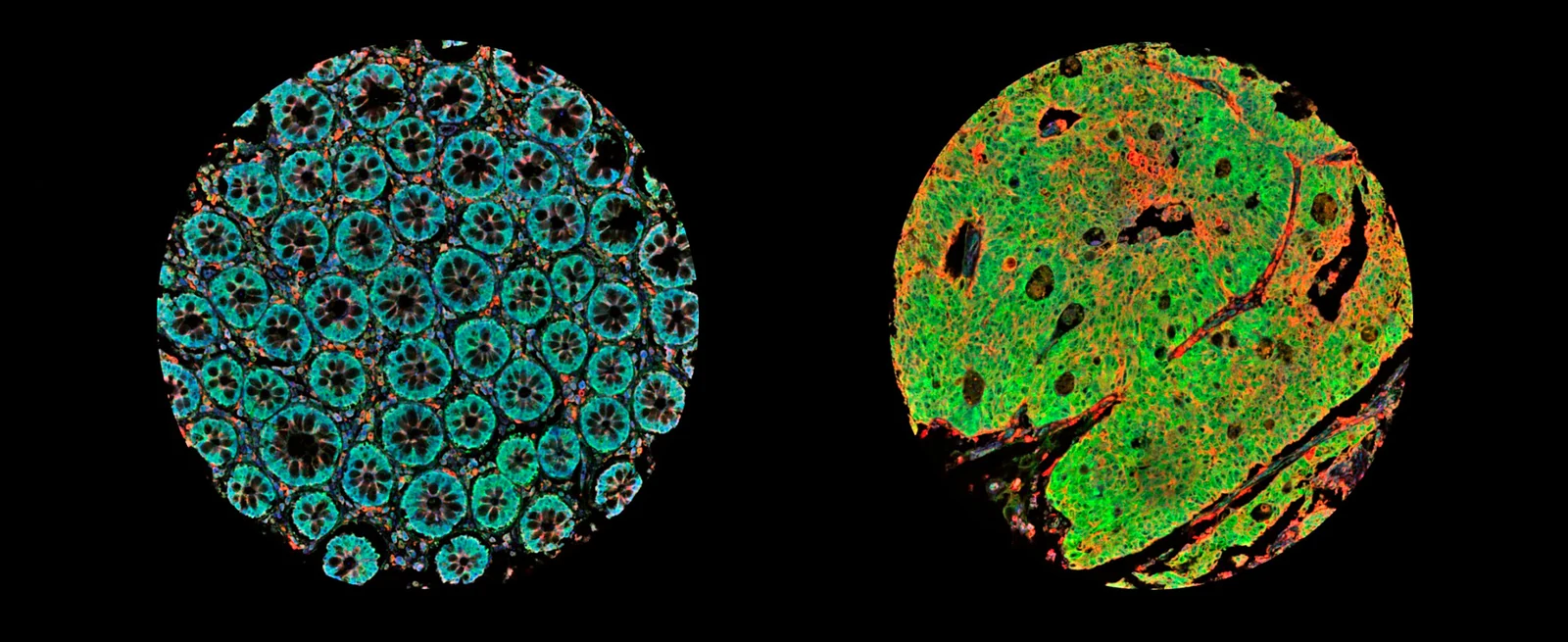
Paired round tissue sections: normal colon with regular gland patterns on the left and colon cancer tissue on the right.
Fluorescence microscopy of normal colon tissue and colon cancer tissue. (Aamir Ahmed, Jane Pendjiky and Michael Millar, CC BY 4.0)

Research Applications

Investigate how vascular phenotype affects antiangiogenic combination-drug response measurements.

Model & Design

Patient-derived colorectal tumoroids and HUVEC vascular networks in a PDMS chip; conditioned and unconditioned endothelial versions.

Experimental Format

50 ng/mL IGFBP5 conditioning; vascular self-assembly, 1:1 mixed medium and perfusion; four-day drug exposure after establishment.

Model Components

  • Component

    Model components

    Description

    Patient-derived tumoroids, HUVECs, IGFBP5, fibrin matrix and central tumoroid compartment.

  • Component

    Measurements

    Description

    Dextran permeability, microbead perfusion, AngioTool vessel metrics and ImageJ tumoroid diameter.

Measurements & Endpoints

  • Relative vessel density
  • Relative tumoroid diameter
  • Vessel length/junctions/discontinuities
  • Permeability and microbead flow

Analysis

Conditioned and original chips are compared within each patient. Clinical resistance is the positive class for sensitivity, and thresholds were fitted within the 22-case cohort.

Published Evidence

  • Study Design

    Compare FOLFOX/bevacizumab chip responses with RECIST-derived clinical response groups.

    Study Sample

    22 patient-derived models with clinical information; experimental assays performed in triplicate per patient.

    Comparison

    Original versus conditioned-HUVEC chips; complete/partial response versus stable/progressive disease.

    Finding

    Optimized model sensitivity 81.82%, specificity 90.91%, accuracy 86.36%; original 54.55%, 90.91%, 72.73%, with resistance as the positive class.

    Interpretation & Limits
    • Threshold selection and evaluation used the same limited cohort.
    • HUVEC conditioning reproduces selected tumor-vessel properties rather than the complete vascular microenvironment.
    • Small-molecule tests remain exploratory; prospective multicenter validation is needed.

Sources

  1. Self-assembly of tumor-related vascularized colorectal tumoroid-on-a-chip for precision medicine drug testing. Cell Reports Medicine (2026). ↗