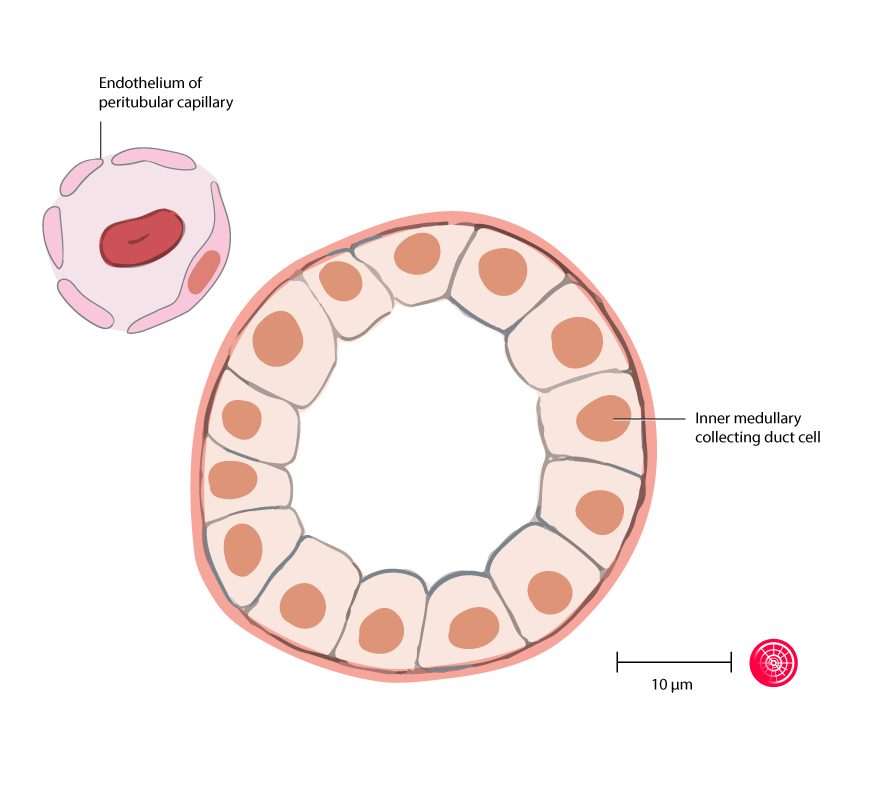
Lithium and AVPR2 Response in Mature Human Collecting-Duct Organoids
Salt-dependent maturation and hormone conditioning support AQP localization and an image-based osmotic-swelling comparison in human collecting-duct organoids.
Study lithium-associated water-transport impairment and engineered AVPR2 dysfunction in a defined human renal compartment.
Model & Design
Collecting-duct organoids generated from healthy-donor iPSC backgrounds 201B7 and RN7, including engineered NFAT5 knockout and AVPR2 Q174R lines with isogenic comparators.
Experimental Format
Stepwise osmotic conditioning up to 900 mOsm/kg with hormones; separate ddAVP, lithium and relative-hypotonic challenge experiments. NFAT5 knockout comparisons use 700 mOsm/kg.
Model Components
Component
Human models
Description
Healthy-donor iPSC ureteric-bud/collecting-duct organoids and engineered isogenic disease-model lines.
Component
Maturation and challenges
Description
Tonicity plus AVP/aldosterone; AVPR2-selective ddAVP after factor washout; 20 mM LiCl with equimolar NaCl comparator; 900-to-450 mOsm/kg osmotic change.
Component
Measurement
Description
AQP2/AQP3 expression and localization, single-cell transcriptomics and phase-contrast time-lapse images with regional-area analysis.
Measurements & Endpoints
Apical AQP2 and basolateral AQP3
ddAVP responsiveness
Regional image-area expansion over 12 minutes
Area under the normalized expansion curve
Analysis
Normalize clearly delineated regional areas at 0, 3, 6, 9 and 12 minutes to the initial area. The normalized two-dimensional regional-area change provides the image-based swelling index.
Published Evidence
Study Design
Compare maturation conditions, then examine lithium exposure and engineered AVPR2 Q174R responses with their matched controls.
Study Sample
Lithium: 20 image regions per condition from four independent experiments. AVPR2: 20 regions per condition from three independent experiments. Two healthy donor backgrounds underlie the iPSC models.
Comparison
Tonicity alone, hormones alone and their combination; 20 mM NaCl comparator for LiCl; isogenic AVPR2 wild type versus Q174R.
Finding
LiCl reduced AQP2/AQP3 and blunted the image-based swelling response: reported peak estimates were 25.9% at nine minutes in controls and 12.0% at six minutes after LiCl. Q174R also reduced ddAVP-dependent AQP2 localization and swelling.
Interpretation & Limits
The drug duration differs across source descriptions: Results says the final six days, while culture Methods lists days 16–20.
NFAT5 knockout organoids cannot tolerate 900 mOsm/kg and were evaluated at 700 mOsm/kg.
This collecting-duct-only model lacks complete nephrons, a urinary outlet and an endogenous corticomedullary gradient.
No multi-drug clinical nephrotoxicity benchmark was reported.
Tonicity and hormone conditioning improve collecting-duct organoid maturation. Lithium lowers water-channel expression and an image-based swelling response; an engineered AVPR2 variant provides a separate functional disease comparison.