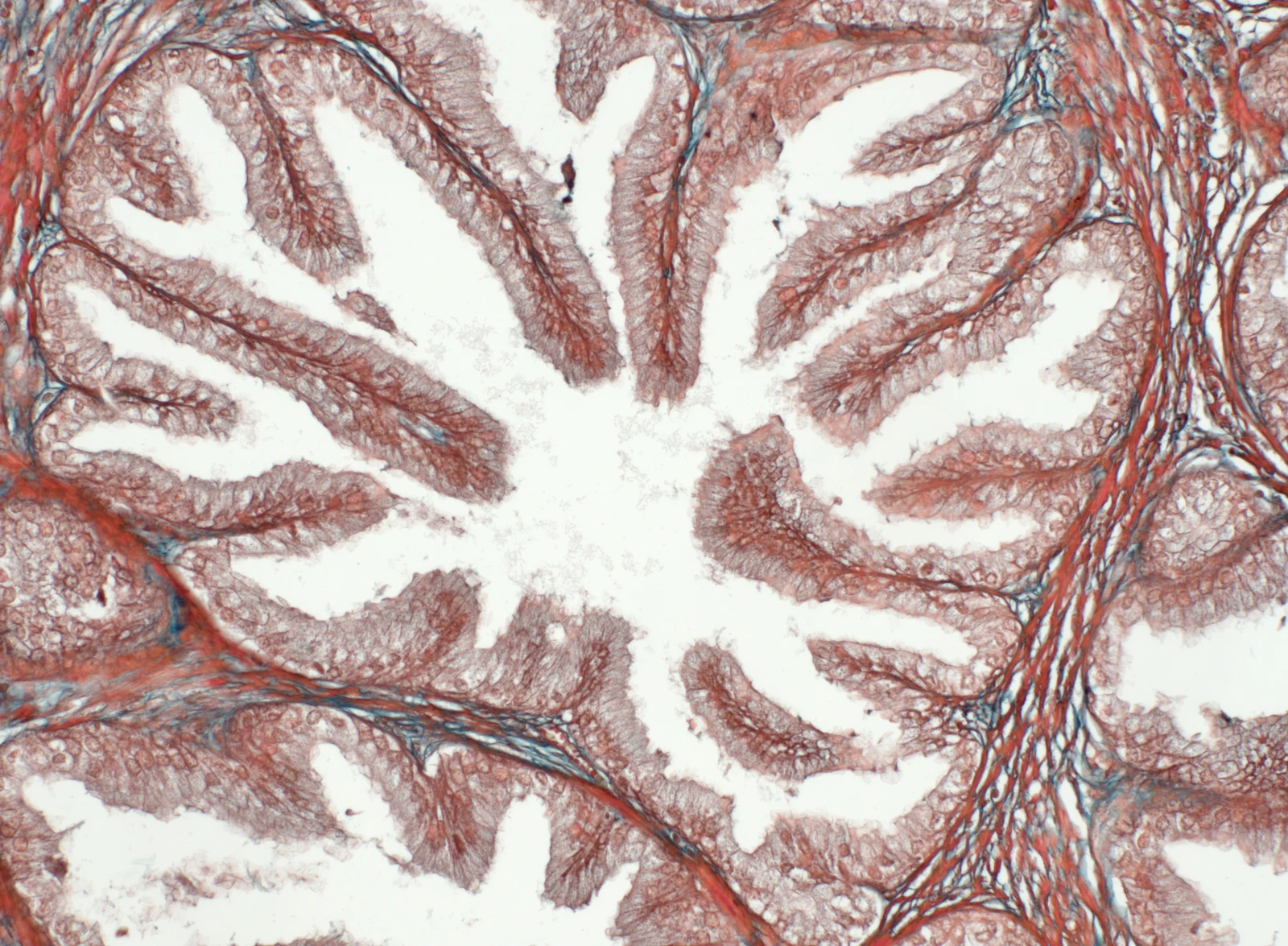
Mechanistic assessment of a transcript-selective intervention in treatment-naive and resistant prostate cancer models.
Model & Design
Organoids from fresh treatment-naive prostatectomy tissue and LuCaP 86.2 castration-resistant PDX-derived organoids.
Experimental Format
CPT1A variant expression with area measurements through day 15; a separate ASO comparison in LuCaP 86.2 organoids.
Model Components
Component
Models
Description
Organoids from fresh patient tissue and LuCaP 86.2 PDXO cultures; prostate cancer cell lines and benign RWPE-1 for distinct supporting assays.
Component
Perturbations and measurements
Description
CPT1A variant 1/variant 2 constructs; THRAP3-site ASO and scrambled control; organoid area, qRT-PCR, RNA immunoprecipitation and cell-line viability.
Measurements & Endpoints
Organoid surface area/growth
CPT1A variant expression
THRAP3 RNA recruitment
Cell-line proliferation and viable/dead-cell proportions
Analysis
Variant-expression experiments use vector controls, and ASO experiments use a scrambled control. Patient-derived and PDX-derived organoids provide separate model comparisons.
Published Evidence
Study Design
Compare CPT1A variants in PDO/PDXO cultures and assess ASO response in LuCaP 86.2 PDXOs.
Study Sample
One LuCaP 86.2 PDX model and fresh treatment-naive patient tissue; the PDO growth assay measured 100 individual organoids per transduction group.
Comparison
Empty-vector or CPT1A variant 1 versus variant 2; separate specific versus scrambled ASO comparisons.
Finding
CPT1A variant 2 promoted organoid growth, whereas variant 1 reduced growth. The ASO reduced LuCaP 86.2 organoid growth; separate cell-line RNA assays confirmed reduced CPT1A variant 2 and THRAP3 recruitment.
Interpretation & Limits
The ASO was not validated as a treatment in vivo.
Cross-line malignant-cell selectivity does not establish clinical safety.
One CIT substrate and a limited set of organoid origins were studied.
Citron kinase regulates THRAP3-dependent RNA splicing in prostate cancer models. An antisense oligonucleotide blocking THRAP3 recruitment to CPT1A pre-mRNA reduced growth in cell lines and a PDX-derived organoid model.