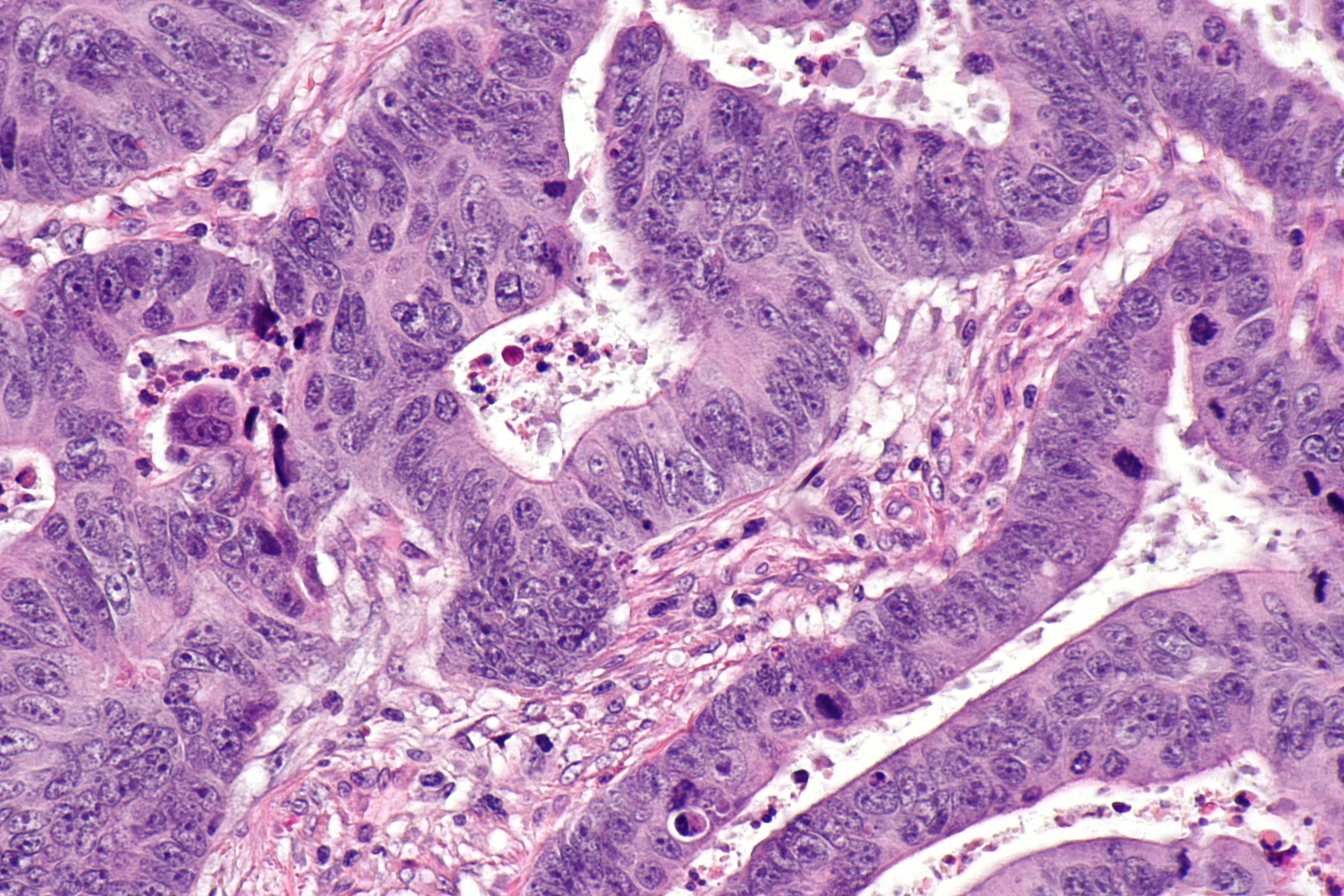
Histological section of colorectal adenocarcinoma. (Nephron , CC BY-SA 3.0 ) Research Applications Compare prolonged drug responses across patient-derived models while tracking population-specific signals.
Model & Design Established, uniquely barcoded colorectal cancer organoids combined into 12- and 15-model pools.
Model Components Component Models
Description Prelabelled patient-derived colorectal cancer organoids with matched tumor/normal molecular information.
Component Measurements
Description Nanopore barcode sequencing and barcode-specific qPCR.
Component Comparators
Description Drug-treated versus vehicle-treated pools, with targeted genotype–drug test cases.
Measurements & Endpoints Barcode-associated relative population change Sequencing–qPCR correlation Detectability after miniaturization Analysis Estimate model-specific response relative to vehicle in the pooled context; assess detection losses separately from measured drug sensitivity.
Published Evidence Study Design Long-term pooled tracking with orthogonal molecular measurement.
Study Sample Pool 1 contained 12 models; pool 2 contained 15; 12 remained analyzable after miniaturization.
Comparison Sequencing versus qPCR and expected TP53–nutlin/RNF43–PORCN relationships.
Finding Sequencing–qPCR correlations were 0.89 for nutlin, 0.79 for LGK-974 and 0.59 for etoposide.
Interpretation & Limits Three models were excluded from the miniaturized assay because untreated signals were insufficient. Exogenous WNT reduced PORCN inhibitor activity. The study did not validate pooled predictions against prospective patient outcomes.