
PBPK-Trained Machine Learning Tests Acid-Reducing Drug Interactions Against Eight Clinical Comparisons
A machine-learning model learned exposure changes generated by mechanistic simulations, then correctly classified seven of eight clinical interaction comparisons. Its missed alpelisib result illustrates why a twofold prediction window and a correct interaction category are different tests.
Learning a Mechanistic Model’s Exposure Predictions
Weakly basic drugs can become less soluble when an acid-reducing medicine raises gastric pH. The resulting change in absorption may reduce systemic exposure. A study led by the Third Xiangya Hospital and Peking Union Medical College Hospital asked whether machine learning could reproduce these interactions quickly enough to support early drug-development screening.
The investigators first built physiologically based pharmacokinetic (PBPK) models for 14 reference drugs. PBPK models connect drug properties with physiological processes to simulate concentration over time. Here, GastroPlus software represented gastrointestinal absorption and systemic disposition. The analysis covered immediate-release tablets and capsules taken under fasting conditions.
The reference models were compared with published pharmacokinetic and acid-reducing-agent interaction studies. Across 18 interaction comparisons, 94.4% of predicted exposure ratios were within a twofold window around the observed ratios. However, the models correctly assigned the exposure-based interaction category in 14 of 18 comparisons. Agreement within a broad numerical window therefore did not always preserve the clinical interaction category.
Sensitivity analysis identified eight influential properties, including solubility, basic pKa, permeability, particle size and precipitation-related parameters. The team generated 5,000 virtual compounds from the reference-drug parameter ranges and simulated each under baseline and elevated gastric-pH conditions. Excluding compounds with interaction exposure ratios below 0.10 left 4,339 virtual compounds for model development.
Strong Internal Agreement Is Against Simulated Labels
The machine-learning output was the ratio of drug exposure with an acid-reducing agent to exposure without one, measured as area under the concentration–time curve, or AUC. The investigators used XGBoost, an algorithm that combines successive decision trees to model nonlinear relationships. Its inputs described drug, formulation and physiological properties; its training targets came from PBPK simulations.
The dataset was divided into training and test portions in an 80:20 ratio, with fivefold cross-validation used for model tuning. In the held-out simulated test data, the reported coefficient of determination was 0.98 and mean absolute percentage error was 2.64%. These results show that the algorithm reproduced patterns within the constructed virtual-drug space.
A feature-attribution analysis identified solubility at pH 6.8 as particularly influential. That finding agrees with the study’s biopharmaceutic premise: the balance between ionization, dissolution and intestinal availability changes as gastric pH rises. It does not independently establish that every parameter combination generated for training occurs in real drugs. The authors explicitly note that the virtual compounds lacked realistic correlations among their physicochemical and pharmacokinetic properties.
The Clinical Check Reveals a Classification Miss
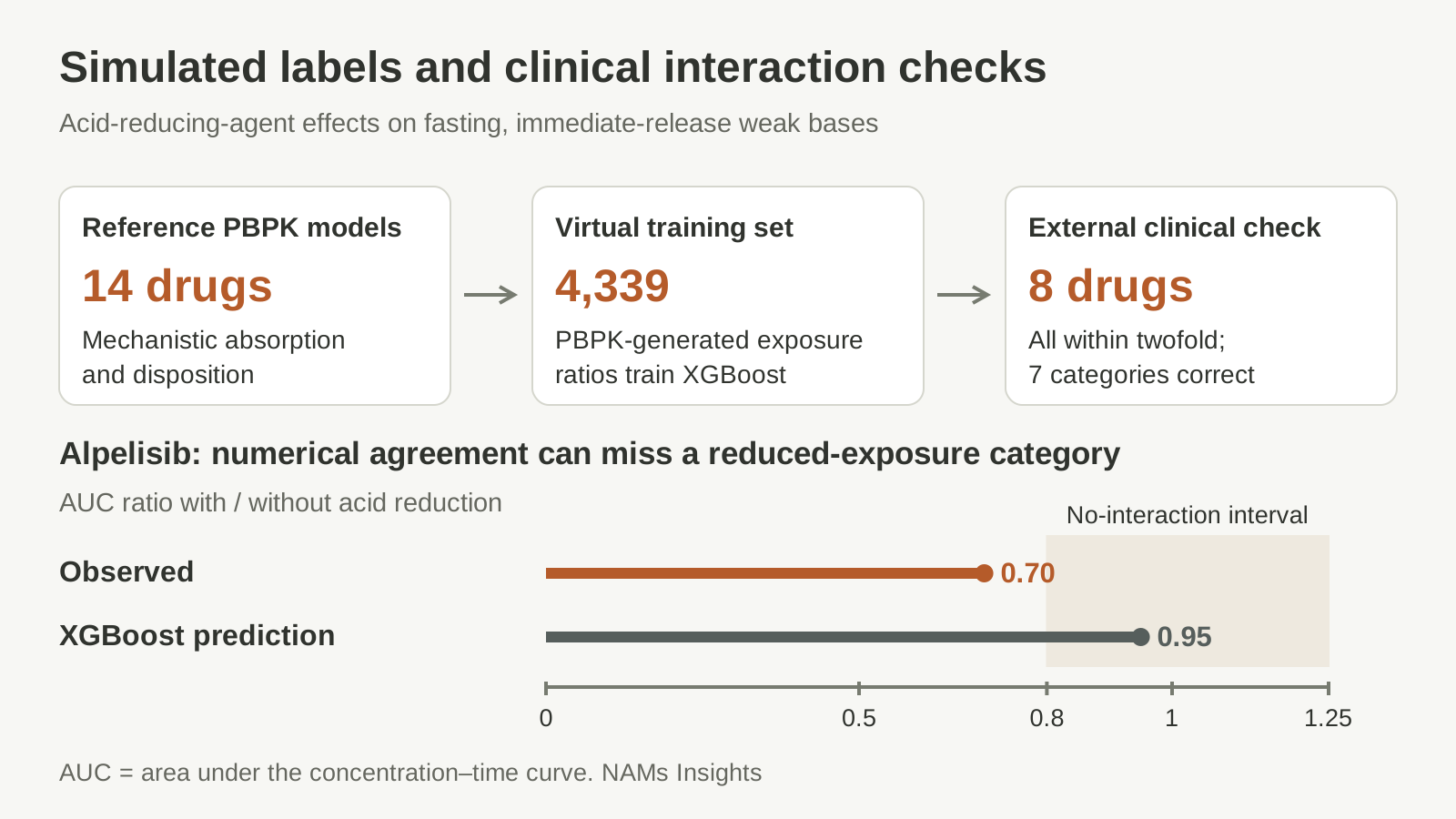
External assessment used observed interaction data for eight additional drugs. All eight XGBoost exposure-ratio predictions fell within 0.5–2.0 times the corresponding clinical observation. Seven of eight interaction categories were correct, compared with eight of eight for the separate PBPK predictions in this set. An exposure ratio within 0.80–1.25 was treated as no significant interaction; values outside that interval indicated an interaction.
Alpelisib was the exception. Its observed exposure ratio was 0.70, whereas XGBoost predicted 0.95. The prediction met the twofold numerical criterion but placed the drug in the no-interaction category. By contrast, the model predicted a ratio of 0.48 for pictilisib against an observed 0.51, retaining the reduced-exposure classification. These drug-level comparisons provide a more concrete account of performance than the high internal fit alone.
The authors also implemented a web application that connects the model with ADMETlab 3.0, a resource for estimating drug properties from molecular structure. This extends the proposed workflow toward early compound screening. The study’s eight-drug clinical evaluation remains a limited test of the model; it does not separately validate every structure-derived input used by that application.
The model’s scope is exposure change for fasting, immediate-release weak bases. It does not predict peak concentration or time to peak, and the training labels inherit the assumptions and errors of the underlying PBPK platform. Within those conditions, it offers a way to prioritize compounds for more detailed interaction assessment, including cases where a numerically acceptable prediction still misses a meaningful exposure reduction.