Three Ways to Represent a Drug
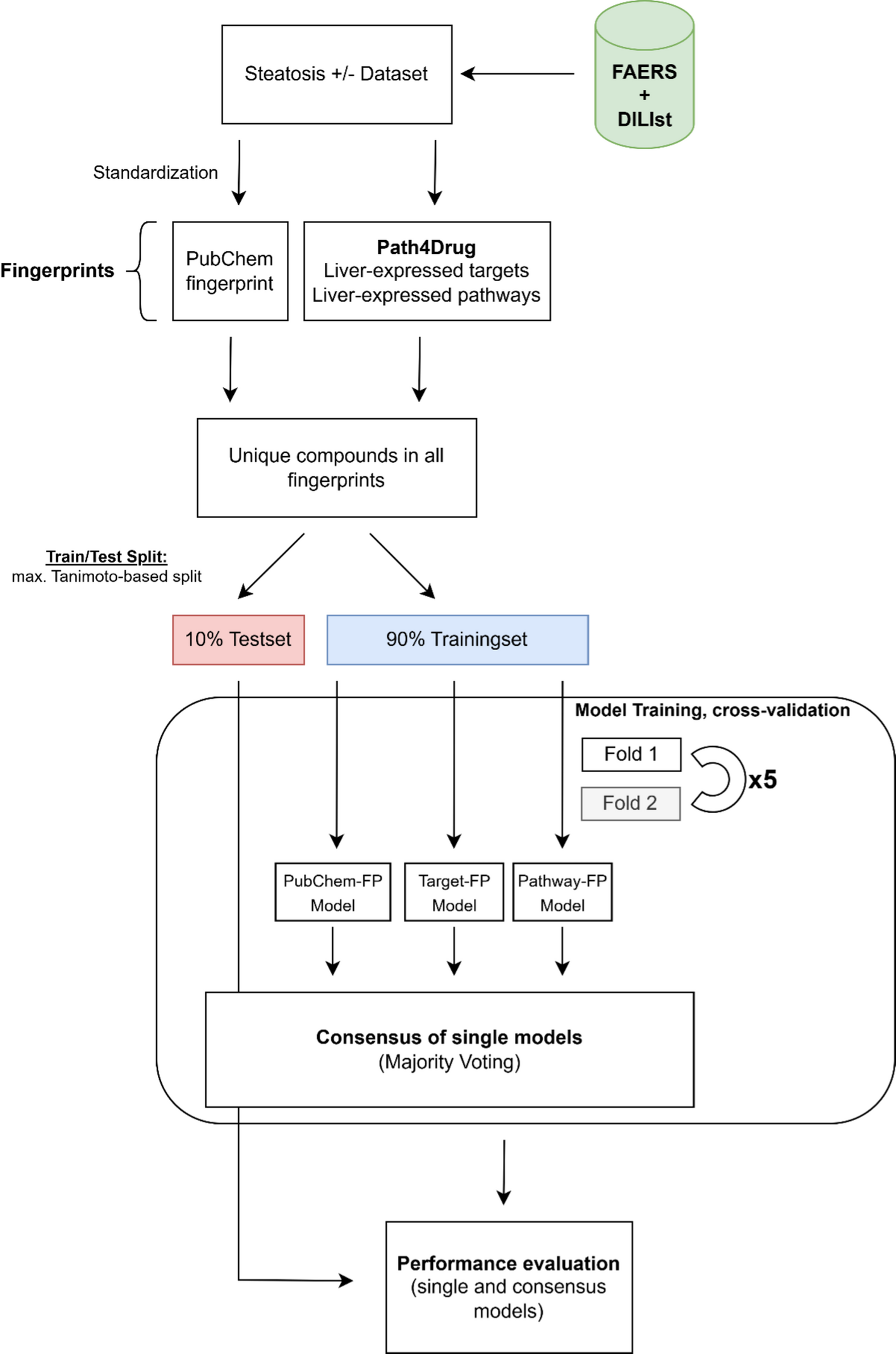
Researchers at the University of Vienna built classifiers for drug-induced hepatic steatosis using three types of information: PubChem structural fingerprints, interactions with human protein targets expressed in the liver, and pathways linked to those targets. They assembled steatosis-positive drug labels from the FDA Adverse Event Reporting System and used compounds classified as drug-induced-liver-injury negative in DILIst as a proxy for steatosis-negative examples. Those labels support a modeling exercise; a spontaneous adverse-event report alone does not prove that a drug caused steatosis.
The common comparison set contained 372 unique compounds, 183 labeled positive and 189 negative. The team used 335 for model development and held out 37 chosen for low similarity to the remaining compounds. Models trained on individual fingerprints were compared with a majority-vote combination of the structural, target and pathway models.
The target and pathway fingerprints were assembled from existing activity databases, with a liver-expression filter applied to the target set. This added biological context to a structural fingerprint, but it also made the representation dependent on the available target annotations. An extensively studied medicine can have a richer interaction profile than a less-characterized compound.
The authors checked the negative-label approximation against LiverTox and found exposure-specific exceptions, including some glucocorticoids and tetracyclines. These remained in the negative class because the dataset did not model dose, route or treatment duration. This choice matters when interpreting a binary prediction: a label in this dataset describes the study’s curation rule, not an assertion that a medicine can never produce steatosis under any exposure condition.
The Independent Tests Were Harder
In 5×2 repeated cross-validation, the biological fingerprints outperformed the structure-only fingerprint. The combined classifier had a balanced accuracy of 0.72 and sensitivity of 0.69. The majority-vote combination did not consistently outperform the individual biological-fingerprint models. These internal values describe performance within the curated development set, not performance in new clinical or laboratory settings.
On the 37-compound holdout selected for low similarity in the combined structural, target and pathway space, sensitivity, precision, Matthews correlation coefficient and balanced accuracy fell, while specificity stayed comparatively stable. The authors then removed overlapping compounds from a separate published steatosis data set, leaving 19 pharmaceuticals—10 positive and nine negative. Both the individual models and the consensus model performed poorly in that external comparison. Similarity to training compounds alone did not explain the failure: external compounds could look similar in the combined feature space yet have neighbors with different steatosis labels.
Where the Signals Come From
Transporters and cytochrome P450 enzymes appeared among influential biological features, but a feature’s importance in this classifier does not establish a causal mechanism.
A further exploratory exercise used predicted targets for compounds with weak reporting signals and little measured interaction information. The authors note that similarity-based target prediction can assign broad interaction profiles to a molecule, which then propagate through pathway features and the final classifier. Agreement among those layers can therefore arise partly from shared inputs. Such outputs are candidates for experimental assessment, and the paper does not present them as newly confirmed steatosis-causing drugs.