Chemical and Biological Fingerprints for Drug-Induced Steatosis Classification
Structure, target-interaction and pathway fingerprints were compared on the same drug set; a majority-vote model was tested internally, on dissimilar compounds and on an independent data set.
Exploratory classification of drugs for steatosis-related safety signals, with attention to whether the model generalizes beyond its development set.
Model & Design
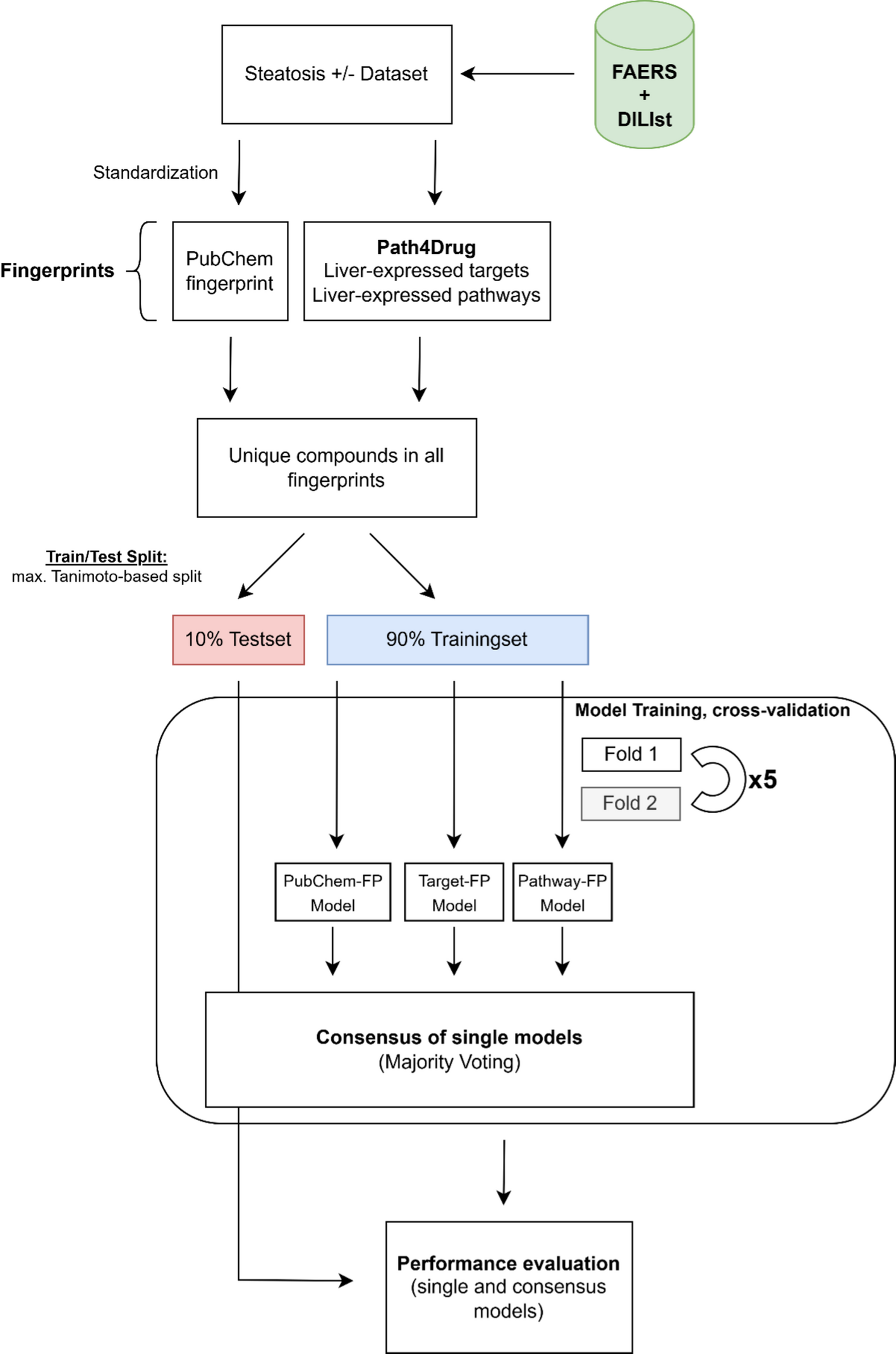
Separate random-forest and gradient-boosted classifiers used PubChem structural fingerprints, liver-relevant human target interactions or mapped pathways. A consensus classifier combined selected single-fingerprint models by majority vote.
Experimental Format
A common 372-drug set (183 steatosis-positive, 189 negative) was split into 335 for training and 37 low-similarity holdouts. A separate nonoverlapping published set contained 19 pharmaceuticals (10 positive, nine negative).
Model Components
Component
Outcome labels
Description
Steatosis-associated reports curated from FAERS for the positive class; DILIst compounds classified as drug-induced-liver-injury negative used as a proxy steatosis-negative class.
Component
Feature sources
Description
PubChem structure bits plus drug–human-target interaction data filtered for liver expression and mapped to pathways. The same common compound set was used to compare input types.
Measurements & Endpoints
Balanced accuracy and sensitivity in 5×2 repeated cross-validation
Sensitivity, precision, Matthews correlation coefficient and balanced accuracy on a low-similarity holdout
Classification performance on 19 independent pharmaceuticals
Analysis
Compare the three fingerprint representations and their majority-vote combination under repeated cross-validation; then examine the 37 least-similar compounds and an independent data set after removing overlapping drugs.
Published Evidence
Study Design
Five repetitions of two-fold cross-validation on the development set.
Study Sample
335 training compounds from the common 372-drug set.
Comparison
Structure-only versus target- and pathway-based models; consensus majority vote.
Finding
Biological fingerprints outperformed structure alone in the internal comparison. The consensus balanced accuracy was 0.72 and sensitivity was 0.69.
Interpretation & Limits
Internal cross-validation does not establish external generalizability.
The label set combines spontaneous reports and a proxy negative class.
Study Design
Low-similarity holdout followed by a separate published steatosis data set after overlap removal.
Study Sample
37 low-similarity holdouts; 19 independent pharmaceuticals, including 10 positive and nine negative.
Comparison
Curated steatosis labels in each test set.
Finding
Sensitivity, precision, Matthews correlation coefficient and balanced accuracy declined on the low-similarity holdout while specificity remained comparatively stable. Both individual models and the consensus performed poorly on the independent 19-drug set.
Interpretation & Limits
FAERS associations cannot establish causality; dose, duration and route were not represented.
Similarity to training compounds in the combined chemical and biological fingerprint space did not by itself establish reliable predictions in the external set.
A University of Vienna team compared chemical-structure, target and pathway fingerprints for drug-induced liver steatosis. Biological inputs performed better during internal validation, while accuracy fell on less-similar compounds and a separate 19-drug set.