Functional Testing in a Small Retrospective Cohort
A study of 12 people with cystic fibrosis carrying the rare CFTR W1282R variant examined elexacaftor/tezacaftor/ivacaftor (ETI) treatment over 3–36 months alongside usual care. Investigators assessed CFTR activity by intestinal current measurement in four people and in two patient-derived intestinal organoid cultures.
The cohort was identified through the Russian Cystic Fibrosis Patient Registry and regional centers. Participants carried W1282R with a second CFTR variant that did not independently confer eligibility for ETI. Ages and baseline disease severity varied. This was a retrospective clinical series with functional tests available for selected participants, rather than a study in which an organoid test was prospectively applied to every patient before a treatment decision.
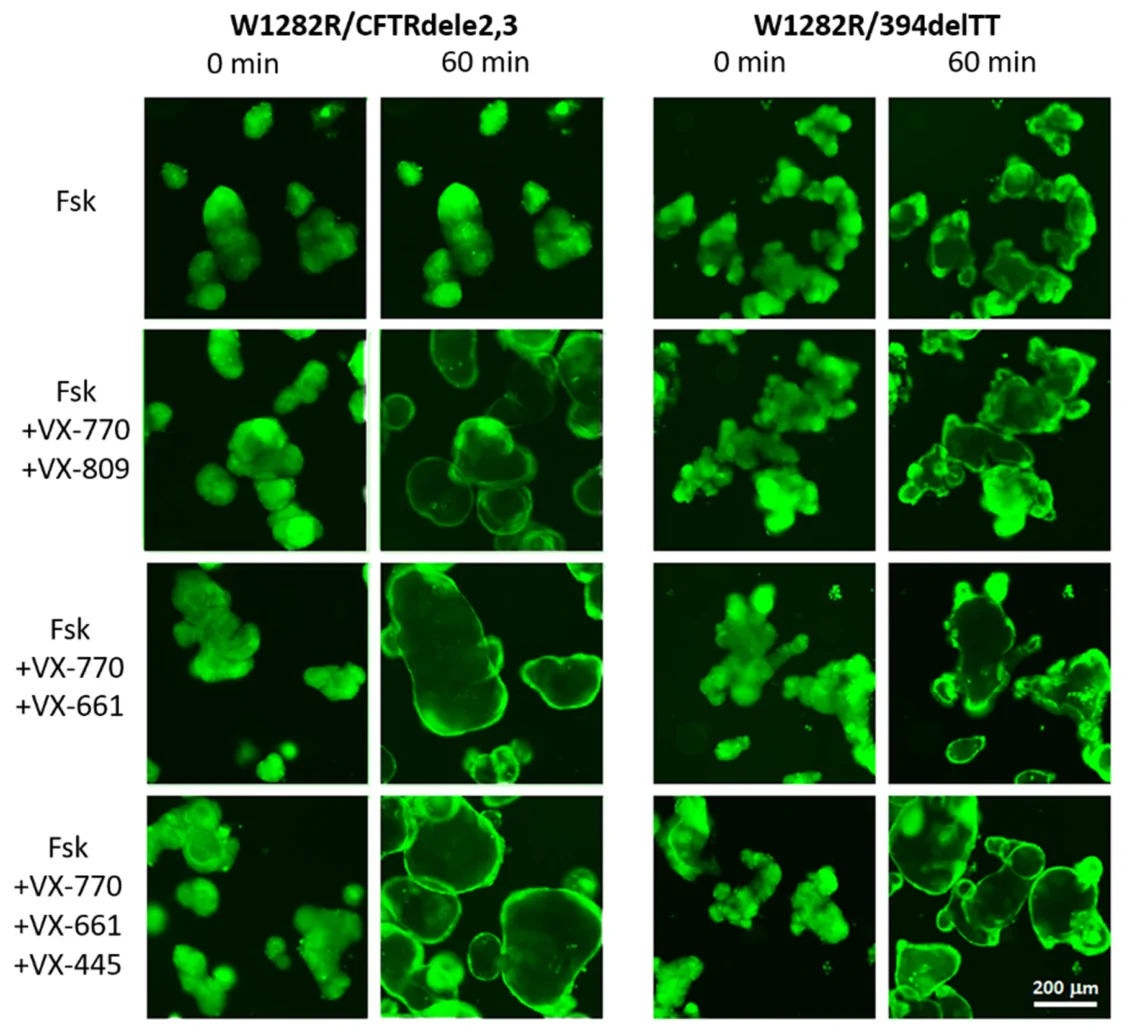
The two functional approaches measured related but different outputs. Intestinal current measurement assessed ion transport in patient tissue. Forskolin-induced swelling measured fluid accumulation in patient-derived organoids after stimulation, providing a readout of CFTR-dependent function in the cultured epithelium. The organoid experiments used one biological culture for each W1282R genotype, with 12 technical replicates, and compared them with a F508del/F508del reference culture.
Partial Rescue in the Intestinal Assays
Without modulators, both W1282R organoid cultures had very low residual swelling responses. Several modulator combinations increased the response, with the largest increase under ETI (p < 0.001 versus forskolin alone for each culture). The reported swelling area under the curve reached approximately 3000 arbitrary units in each W1282R culture, compared with approximately 4700 in the reference culture. This supported functional responsiveness but did not show identical rescue across genotypes.
The most direct before-and-during-treatment tissue comparison came from one participant. After two years of ETI, that person’s forskolin-induced intestinal current rose from 1.17 ± 0.41 to 24.17 ± 6.02 μA/cm². The two participants whose organoids were tested had intestinal-current measurements only during treatment. The different timing of these observations limits direct comparison between the assays and between participants.
The Clinical Measures Did Not Move Together
Paired lung-function data were available for eight people. Baseline lung function was generally high in those measured, with median percent-predicted FEV1 of 110% (interquartile range, 93–123%), and the study did not detect a significant change during treatment (p = 0.328). Body mass index was also not significantly changed (12 paired observations; p = 0.269). Sweat conductivity fell by a median of 3 mmol/L among nine paired observations (p = 0.031), but a marked reduction occurred in only two of the nine.
Individual clinical courses helped explain why a positive functional test was not followed by a uniform clinical pattern. The participant with paired current measurements had higher body mass index and a modest lung-function increase, while sweat conductivity changed little. One organoid-tested participant began with high lung function and remained stable; another showed functional responses without improved nutritional status or a changed sweat test. Progression of sinonasal disease was also reported in several participants with available follow-up.
The authors discuss both baseline ceiling effects and possible differences between intestinal and respiratory tissues. High initial lung function can leave limited room for a measured increase, whereas discordance in sweat-test results raises a separate tissue-response question. The small retrospective subsets and incomplete longitudinal data prevented the study from estimating a reliable relationship between organoid swelling and the size of an individual patient’s clinical benefit. The practical contribution is the combination of functional and clinical measurements, including their disagreements.