
NOTUM Protects Colorectal Tumoroids from T-Cell Killing in a Mouse Coculture Model
Human tumor analyses identified a WNT-inhibitory cancer-cell state. Mouse tumoroid–T-cell experiments then tested how removing that population or its secreted factor changed immune killing.
Linking a Human Tumor State with a Functional Model
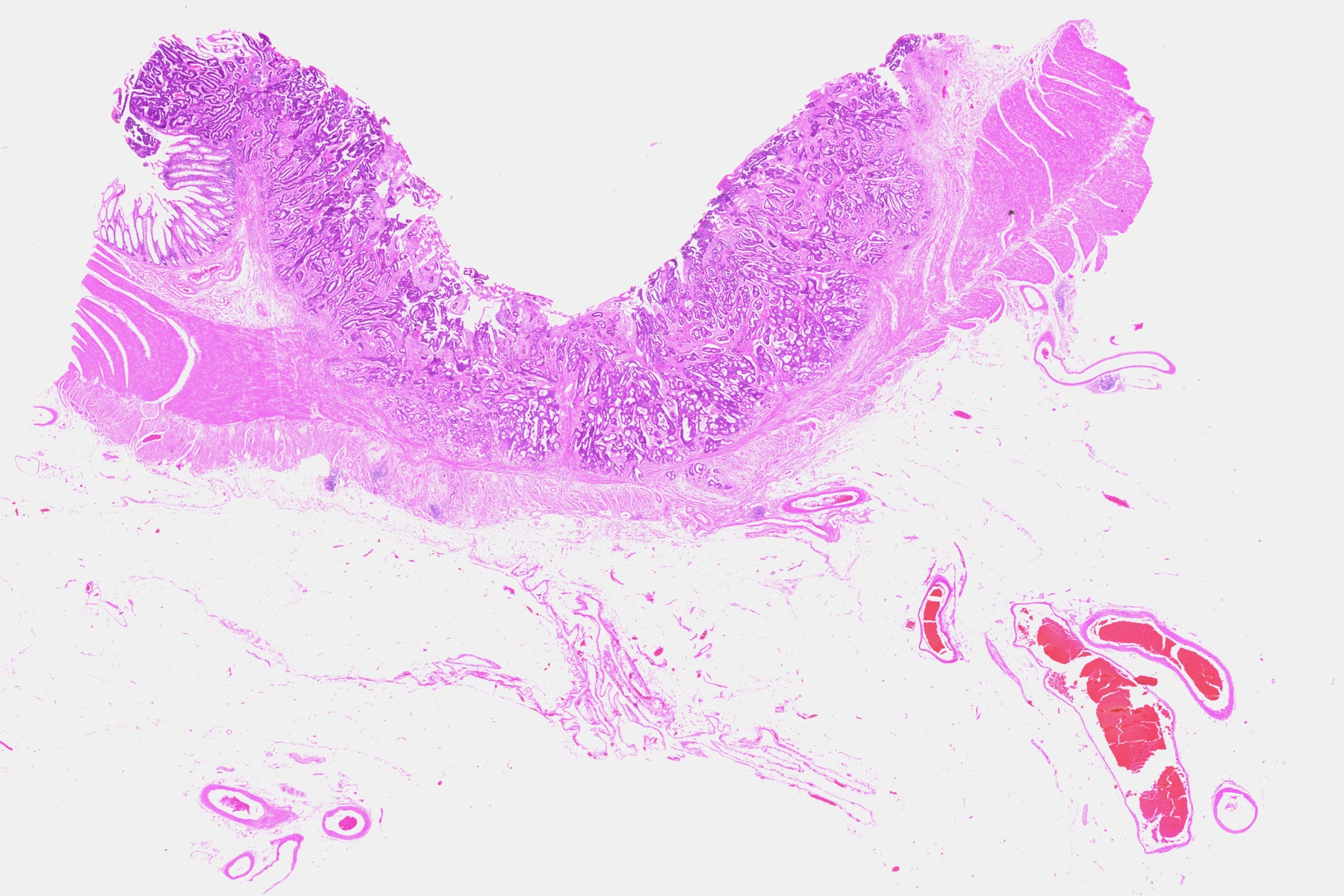
University of Calgary researchers identified a WNT-inhibitory colorectal cancer-cell state, termed WICC, through analyses of human tumors and patient-derived organoids. The program was enriched in microsatellite-stable cancers, associated with immune exclusion and linked with worse clinical outcomes. NOTUM, a secreted WNT-inhibitory enzyme, was one of the factors investigated.
To test its functional role, the team used a separate mouse tumoroid system. The AKP model combined Apc and Trp53 loss with mutant Kras. Antigen-specific OT-I CD8-positive T cells recognized an ovalbumin-derived antigen expressed by the tumoroids. This controlled pairing allowed the investigators to test a defined tumor–T-cell interaction.
Removing the WICC Population Changes Tumor Killing
A lineage-selective system allowed WICC cells to be depleted within the mouse tumoroids. Depleting that population alone did not substantially reduce tumoroid viability. T-cell coculture alone produced moderate cell death, while combining WICC depletion with T cells caused structural collapse and much greater loss of viable tumor cells.
In the combined condition, 72% of tumoroids contained more than 50% dead cells according to the study's viability staining. T cells also accumulated more extensively around the depleted tumoroids. Separate experiments quantified surface coverage and the proportion of structures retaining at least half of their viable cells, providing spatial and functional measures of the response.
Adding Back NOTUM Restores Protection
Recombinant NOTUM increased tumoroid survival when added back to WICC-depleted cocultures. The rescue experiment connected a secreted factor with the protection supplied by the original cell population. Genetic deletion of Notum did not itself impair tumoroid growth in the reported culture comparison.
In a separate mouse transplantation experiment, Notum-deficient tumors grew more slowly and had greater endogenous CD8-positive T-cell infiltration even without adoptive T-cell transfer. Loss of Notum alone did not eliminate the tumors. With antigen-specific T-cell transfer, established Notum-deficient tumors were cleared, whereas Notum-expressing tumors persisted.
Examining the T-Cell Response to Extracellular WNT Inhibition
The researchers also treated activated T cells with WNT3A and recombinant NOTUM. NOTUM suppressed several WNT-responsive transcriptional changes, including programs involving TCF7, CCR7 and BCL2. These genes relate to T-cell maintenance, migration and survival. Human single-cell data provided a parallel association between the WICC-rich tumor state and altered T-cell transcription.
The findings support a model in which a tumor-cell population changes its extracellular signaling environment and thereby limits the ability of T cells to engage the tumor. The coculture, factor add-back and genetic experiments address successive parts of that explanation, while the human analyses connect the proposed mechanism with an observed cancer-cell state.
An Assay for Immune Resistance, with Defined Model Boundaries
For NAMs drug research, the functional system offers a way to compare candidate strategies that alter tumor-mediated immune resistance. Its mechanistic advantage is the use of matched perturbations and a defined antigen-specific effector population. The demonstrated killing and rescue experiments were performed in mouse tumoroids; the human organoids supported the identification and characterization of the cell state.
The work did not establish the efficacy of a NOTUM-targeted treatment in patients or validate a patient-specific response predictor. It supplies preclinical evidence that removing the WICC-associated protective signal can change immune killing, with both the in vitro rescue and the independent mouse experiments contributing to that conclusion.