Tumor, Stromal and Immune Cells in One Model
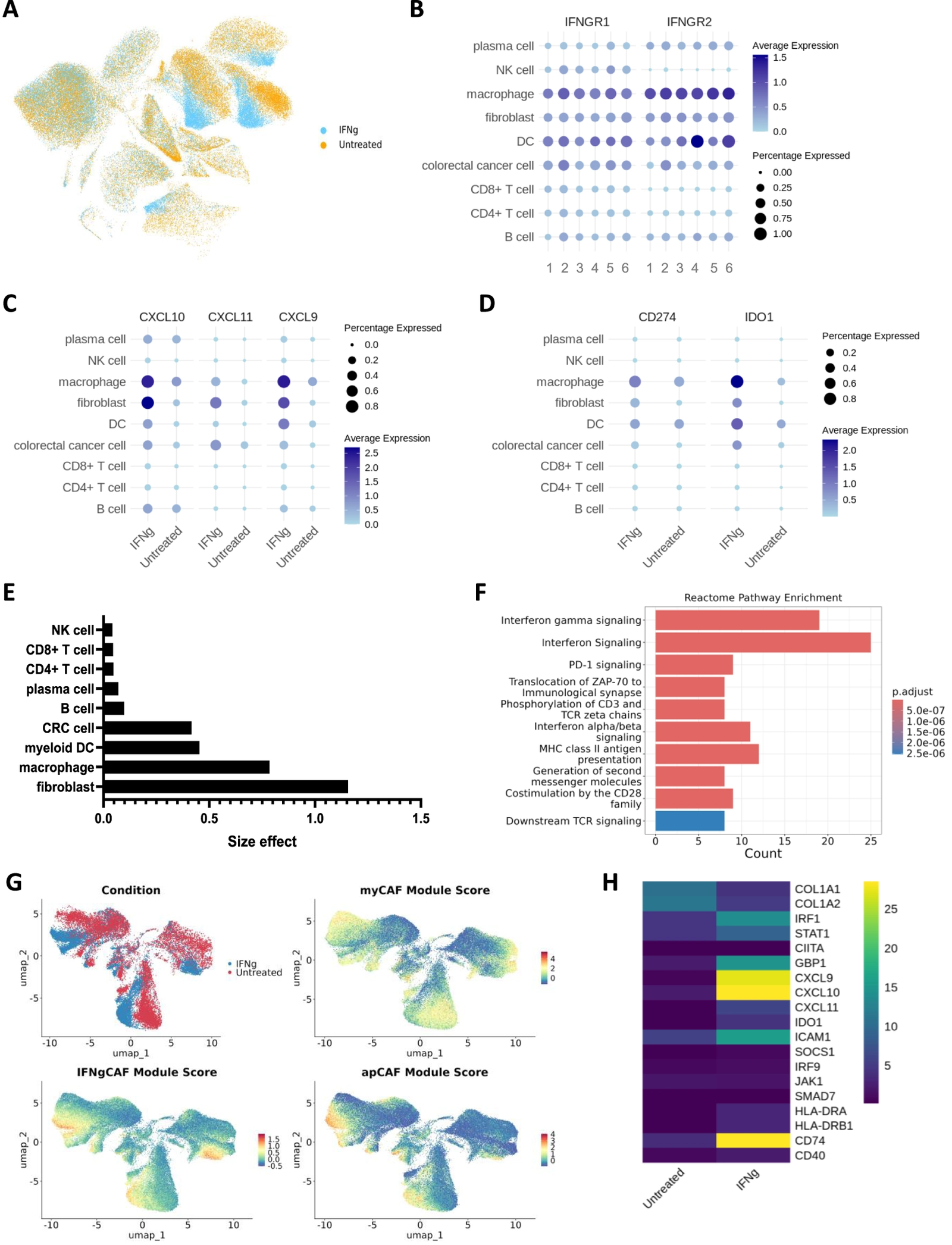
The Roche research team assembled patient-derived colorectal cancer organoids with fibroblasts from the same tumors and allogeneic peripheral blood immune cells in a three-dimensional matrix. Imaging and single-cell RNA sequencing showed tumor, stromal and several immune-cell populations in six patient-derived lines. Many immune cells remained in stromal-rich regions, giving the researchers a way to examine where a cytokine acts within the construct.
Recombinant interferon-gamma (IFNγ) reduced tissue area and Ki67 staining in the assembloids. It also increased CXCL10 release, CD8-positive T-cell migration, MHC-I and PD-L1. Response magnitudes differed across patient-derived lines. These observations provided the comparison for Roche’s own FAP-targeted IFNγ receptor agonists.
Single-cell profiles identified fibroblasts as particularly responsive to recombinant IFNγ; fibroblasts and macrophages were prominent sources of T-cell-attracting chemokine transcripts. Fibroblasts also shifted away from a structural, myofibroblast-like expression program toward one associated with antigen presentation. Protein imaging supported the rise in antigen-presentation markers in the fibroblast population. These measurements connected the secreted CXCL10 signal to changes within identifiable cell types rather than treating the assembloid as a homogeneous tumor mass.
The model captured opposing immune effects: T-cell-attracting signals and antigen-presentation machinery increased alongside PD-L1 and other immunoregulatory signals. Measuring both gave a broader therapeutic comparison than tissue area or Ki67 alone.
The Targeted Molecules Gave a Narrower Response
The engineered molecules were designed to bind fibroblast activation protein (FAP) on cancer-associated fibroblasts while activating IFNγ receptors. The cis and trans labels describe where receptor activation occurs relative to the FAP anchor. In the cis configuration, binding to FAP and activation of the IFNγ receptor occur on the same fibroblast. In the trans configuration, a molecule anchored to a FAP-positive fibroblast can activate a receptor on a neighboring cell. The study also examined an integrated all-in-one format. These spatial arrangements are a reason to use a model with adjacent stromal, tumor and immune cells, rather than evaluating every construct solely in a single-cell assay.
The investigators included an untargeted reference lacking the FAP-targeting arm to help distinguish attenuation from localization. Simpler two-dimensional assays assessed early T-cell activation and construct activity.
In dose-response experiments, targeted cis and trans configurations induced CXCL10, though less strongly than the untargeted cytokine. At the 100 nM concentration used for the main comparison, the targeted molecules produced little PD-L1 upregulation relative to recombinant IFNγ.
Functional measures showed a narrower effect. Recombinant IFNγ significantly reduced Ki67-positive tissue, whereas Ki67 reduction with the targeted cis/trans molecules was a trend that did not reach statistical significance. Their increase in CD8-positive T-cell migration was likewise not significant over untreated controls; recombinant IFNγ and the untargeted reference produced stronger migration signals. Reduced PD-L1 induction did not by itself demonstrate improved tumor killing or clinical advantage.
Study Ownership and Model Scope
Roche funded and performed the work on its own therapeutic constructs. Its employees collected and analyzed data and wrote the paper; several authors disclosed company stock or patents. The assembloids used allogeneic immune cells and lacked vascular and systemic immune interactions.