
Review Examines Clinical Response Prediction Across 12 Ovarian Cancer Organoid Studies
A systematic review found encouraging organoid–patient associations alongside differences in models, drug tests and clinical endpoints. Two prospective studies supplied the strongest accuracy estimates, from separate evaluable populations.
Selecting Studies with a Direct Clinical Link
A systematic review from Erasmus MC examined whether ovarian cancer organoids reflect treatment responses in the patients who supplied the material. The review selected studies that directly compared a drug response in a patient-derived three-dimensional model with a corresponding clinical outcome. This focus separated clinical prediction evidence from studies concerned only with model establishment or laboratory drug activity.
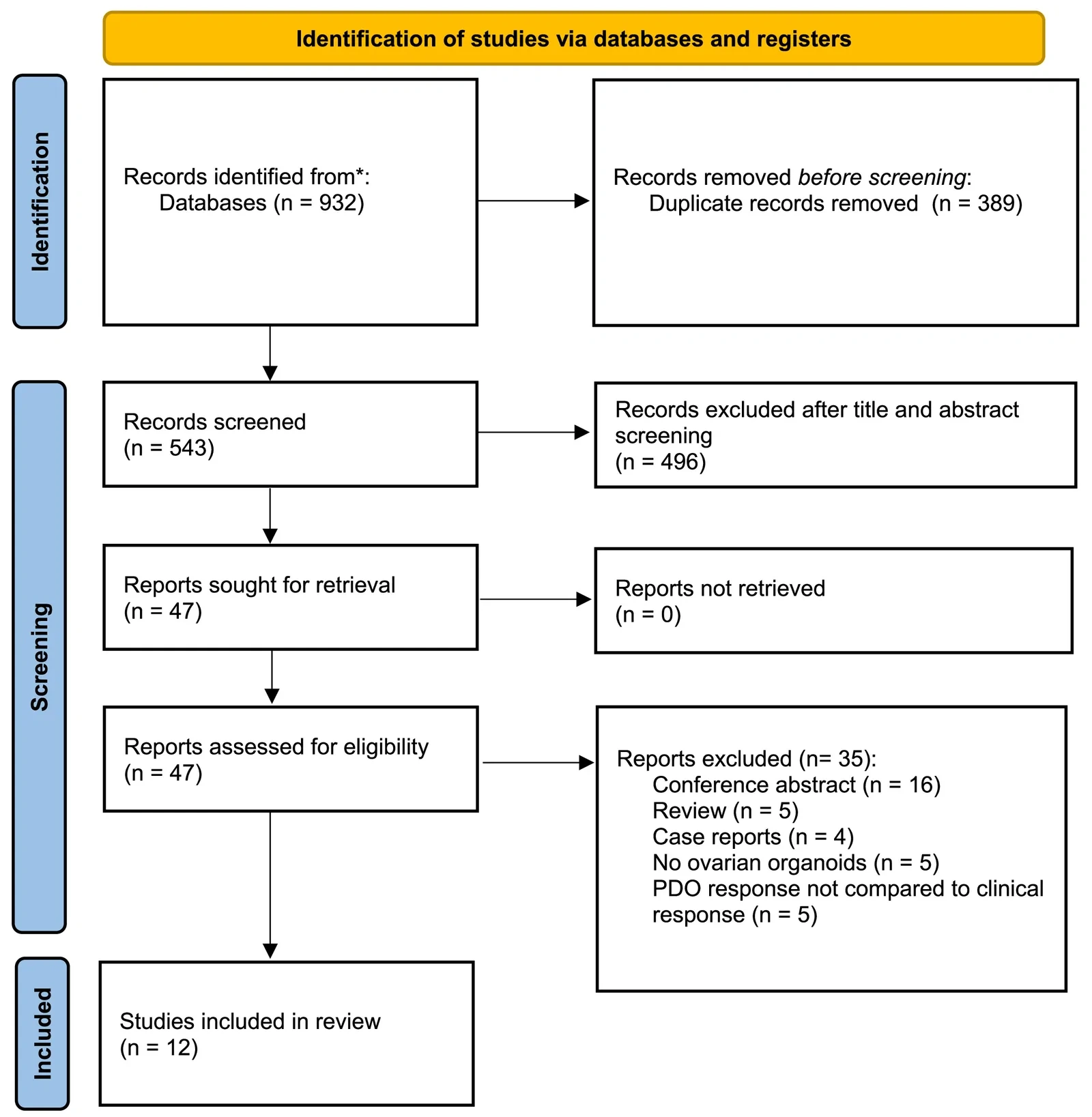
The search covered databases through January 29, 2026. From 932 identified records, 47 reports underwent full-text assessment and 12 studies were included. The studies were published between 2019 and 2026 and covered ovarian, fallopian tube or primary peritoneal epithelial malignancies. The evidence included two prospective validation studies and a larger group of retrospective, feasibility or translational comparisons.
Short-Term and Expandable Models Serve Different Designs
The review included short-term tissue-derived spheroids and organoid formats alongside long-term expandable organoids. Short-term systems prioritized testing within days and generally did not support sustained propagation or biobanking. Long-term cultures supported repeated drug testing, cryopreservation and molecular characterization, with longer establishment periods.
Ten of the twelve studies compared models with the original tumors using histology, marker staining, genomic analysis, transcriptomics or combinations of these methods. The depth of characterization varied. Two studies relied mainly on functional drug response without an explicit matched histological or molecular comparison.
Drug experiments also differed. Most tested platinum agents and taxanes; some included PARP inhibitors or other targeted therapies. Exposure and assessment times ranged from several days to more than one or two weeks. ATP-associated viability, metabolic assays and imaging generated different response measures, which were then classified using IC50, area under a concentration-response curve or study-specific sensitivity thresholds.
What the Prospective Accuracy Estimates Represent
The strongest numerical evidence came from two prospective studies, which should be considered separately. A blinded short-term-model study reported 89% accuracy, or 39 of 44 cases, for predicting first-line platinum-based treatment response. Sensitivity was 86% and specificity was 100%; the specificity estimate had a wide 95% confidence interval of 64.6%–100%. Clinical classification used imaging and/or CA-125 criteria.
A prospective long-term-organoid study had 12 evaluable patients for its first-line carboplatin–paclitaxel comparison. It reported 91.7% accuracy, 100% sensitivity and 66.7% specificity. The specificity confidence interval was again wide, at 12.53%–98.2%. The study also described PARP-inhibitor cases in which functional response contributed information alongside genomic homologous-recombination-deficiency status.
These figures are study-specific estimates, rather than a pooled accuracy for ovarian cancer organoids. The review used narrative synthesis because differences in platforms, clinical endpoints and analysis prevented a quantitative meta-analysis.
Concordance Depends on the Experimental and Clinical Context
The remaining studies provided varied forms of support: group-level associations, small case series, mixed endpoint results and descriptive clinical comparisons. One study found a significant relationship with CA-125 change only when the organoids were maintained in human plasma-like medium. Another observed a trend toward shorter platinum-free interval in the resistant group, alongside discordant cases and mixed results for other outcomes.
Clinical response definitions included radiological response, CA-125 changes, histopathological response scores, progression-free survival and the subsequent clinical course. These endpoints measure different aspects of treatment. Some studies tested single drugs although patients received combination chemotherapy, introducing a mismatch between the laboratory comparison and the clinical regimen.
Where Validation Needs to Become More Consistent
The review identifies successful culture as a potential selection step. Patients whose tissue does not grow, or whose outcomes cannot be evaluated, may disappear from the final accuracy calculation. Establishment success, attrition and the size of the clinically evaluable group therefore need to be reported separately.
Most epithelial organoid cultures also lack the immune, fibroblast and endothelial populations that influence many therapies. That limitation matters especially when the treatment acts through those compartments. Drug concentration and exposure need their own justification because a laboratory concentration does not automatically reproduce the patient's exposure.
The review supports continued clinical validation with matched treatment regimens, predefined endpoints and explicit sensitivity, specificity and accuracy calculations. Its overall message is an encouraging clinical signal across several model formats, with the most informative prospective estimates still coming from small, distinct cohorts. Larger multicenter studies would clarify where the assay can reliably contribute to treatment decisions.