
Bladder Cancer Organoids Link Chemotherapy Responses with Postoperative Follow-Up
A small bladder cancer study completed drug testing for 12 of 22 patients. Chemotherapy comparisons were linked with postoperative follow-up, while disitamab vedotin was evaluated only in organoids.
From Surgical Tissue to a Drug Result
Researchers at the First Affiliated Hospital of Soochow University and collaborating academic institutions tested whether bladder cancer organoids could support drug-response comparisons within a clinically useful time window. The study established organoids from 19 of 22 patients and completed drug-sensitivity testing for 12. One culture was contaminated, and six had insufficient growth after 30 days.
The distinction between initial growth and a usable drug result is important to the reported feasibility. A completed screen was available for 12 of the 22 enrolled patients, or 54.5%. Among completed assays, the median interval from specimen collection to a result was 15 days, with a range of 10–25 days. The organoids were compared with the source tumors through morphology and marker staining.
Chemotherapy and ADC Responses
The investigators measured ATP-associated viability after 72 hours of drug exposure and derived concentration-response measures including IC50, area under the curve and maximum inhibition. The chemotherapy panel included gemcitabine, cisplatin, epirubicin and pirarubicin, as well as gemcitabine–cisplatin. Not every patient-derived model was tested with every regimen.
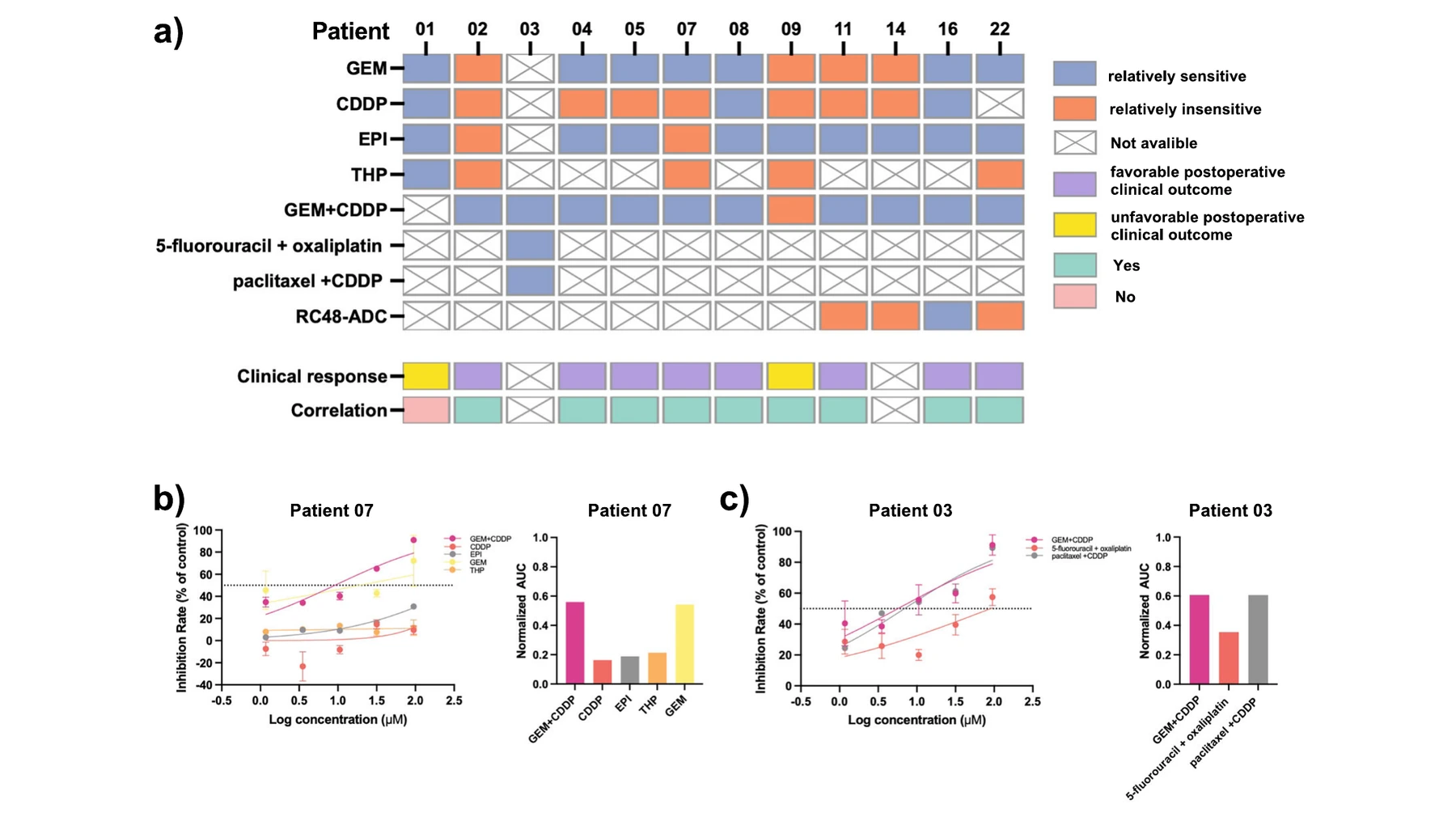
Using an exploratory classification based on IC50 relative to a drug's maximum plasma concentration, the gemcitabine–cisplatin combination was classified as relatively sensitive in 9 of 10 tested models. The corresponding counts were 9 of 11 for epirubicin, 7 of 11 for gemcitabine, 3 of 10 for cisplatin and 1 of 5 for pirarubicin. These separate denominators describe the tests actually completed.
Disitamab vedotin, also called RC48, added an antibody–drug conjugate to the panel. Four organoid models were tested, with one classified as relatively sensitive. Additional gemcitabine experiments connected drug response with changes in proliferation and cleaved caspase-3, providing a biological comparison alongside the ATP-based assay.
What the Clinical Comparison Measured
Ten patients had evaluable postoperative follow-up, and the investigators reported agreement between the organoid classification and clinical outcome in nine. The median follow-up was 1.19 years. All patients had undergone resection without measurable residual disease, so the comparison concerned subsequent recurrence or progression rather than shrinkage of an existing target lesion.
Treatment was selected according to standard clinical care and physician judgment. The organoid test did not assign the regimens. This design offers an initial clinical comparison, while surgery, disease characteristics and subsequent care also contribute to postoperative outcome. No patient in this cohort received RC48, so the ADC arm had no corresponding clinical-response validation.
Assay Yield and Validation Are Separate Questions
The study brings together three practical measures: whether a culture can be established, whether enough material grows to complete testing, and whether the resulting classification agrees with a defined clinical endpoint. Reporting each stage preserves the losses that occur before a result is available. The 90% agreement belongs to the ten evaluable postoperative cases, rather than the entire enrolled cohort.
For drug research, the model supports paired comparisons across several treatment classes and follow-up of variable patient-derived responses. Larger prospective studies would be needed to establish a validated decision rule. The present data give an early estimate of assay feasibility and a small clinical association, with the chemotherapy and ADC evidence remaining at different stages.