
Ovarian PDO and Xenograft-Derived Organoids Retain Platinum Patterns with Model-Specific Exceptions
Organoids from five ovarian cancer patients and their matched xenografts broadly reflected existing platinum-response classifications. Paclitaxel and combination responses varied with derivation route, showing why direct and xenograft-derived cultures are not interchangeable in every condition.
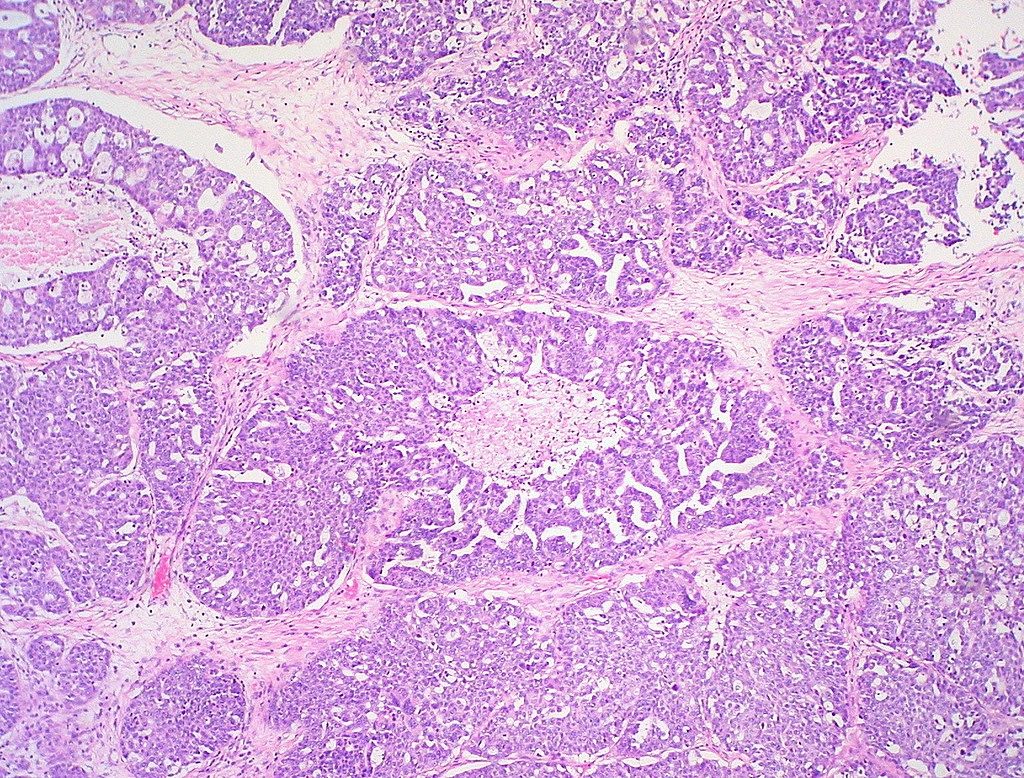
Three Derivation Routes from Five Patients
A University of New Mexico study in BMC Cancer compared ovarian cancer organoids made directly from patient material with organoids established after mouse xenografting. The aim was to assess whether expandable xenograft material could provide a continuing source for drug testing while retaining relevant response patterns.
The five patients all had high-grade serous ovarian carcinoma: two were clinically platinum sensitive, two resistant and one refractory. Direct patient-derived organoids, or PDOs, came from malignant ascites. Matched patient-derived xenograft organoids, or PDXOs, came from ascites or solid tumors recovered from the corresponding mouse xenografts. The animal stage expanded material from the same patients.
Direct ascites PDOs generally formed over 7–14 days, compared with 7–10 days for xenograft ascites cultures. Solid-tumor PDXOs produced small structures after two to three days and larger ones by six to nine days. The cultures were maintained for at least nine passages, with some reaching sixteen; drug experiments used passages three through nine.
A Shared 72-Hour Pharmacology Comparison
The investigators placed 20–30 preformed organoid units in each well and treated them for 72 hours with 1 μM carboplatin, 10 nM paclitaxel or their combination. ATP-based CellTiter-Glo 3D measurements were compared with a vehicle condition, while 10 μM afatinib supplied a positive killing control.
Each condition had at least six technical wells, and each model underwent two independent screening runs. These repeats improve confidence in the assay comparison within a model. Clinical classification remained a five-patient, retrospective reference rather than a prospectively tested prediction endpoint.
Platinum-Sensitive Models Responded, with Differences in Magnitude
Models from the two platinum-sensitive patients showed reduced viability after the drugs and their combination, broadly matching the clinical classification. Several reductions were around 50%, although some single-drug effects in xenograft-derived models were closer to 30%. Response magnitude therefore varied even where the overall sensitive pattern was retained.
The resistant cases exposed more specific differences. For patient 2, the direct PDO resisted carboplatin and the combination but showed a roughly 17% reduction with paclitaxel. The xenograft-ascites model resisted all three conditions. Its solid-tumor counterpart showed approximately 27% lower viability with paclitaxel and 16% lower viability with the combination.
In the other resistant case, patient 80, combination treatment produced a small but significant increase in viability relative to control. All three derivation routes from the refractory patient showed no response to the tested drugs. The resistant and refractory results therefore include both nonresponse and route-dependent exceptions, rather than one uniform pattern.
Expansion Preserves Useful Material and Can Select Cell Populations
The study supports using xenograft-derived organoids to generate repeated experimental material and to prioritize compounds before further in vivo testing. It also shows that passage through a mouse and sampling from ascites or a solid tumor can change a measured drug response. The authors discuss selection during derivation and expansion, alongside underlying tumor heterogeneity, as possible explanations.
Five patient histories and a short, fixed-dose assay cannot establish general prediction accuracy. The cultures also lack the full stromal and immune environment and do not reproduce long-term resistance evolution. The useful result is the paired comparison: broad platinum-response patterns survived across derivation routes, while specific paclitaxel and combination effects required model-by-model interpretation.