
Virtual-Cell Roadmap Links Drug Prioritization to Matched Benchmarks and Experiments
A review proposes evaluating virtual cells through the chain from perturbation data to prediction, uncertainty and experimental challenge. Its framework treats drug ranking as decision support whose evidence should match the intended use.
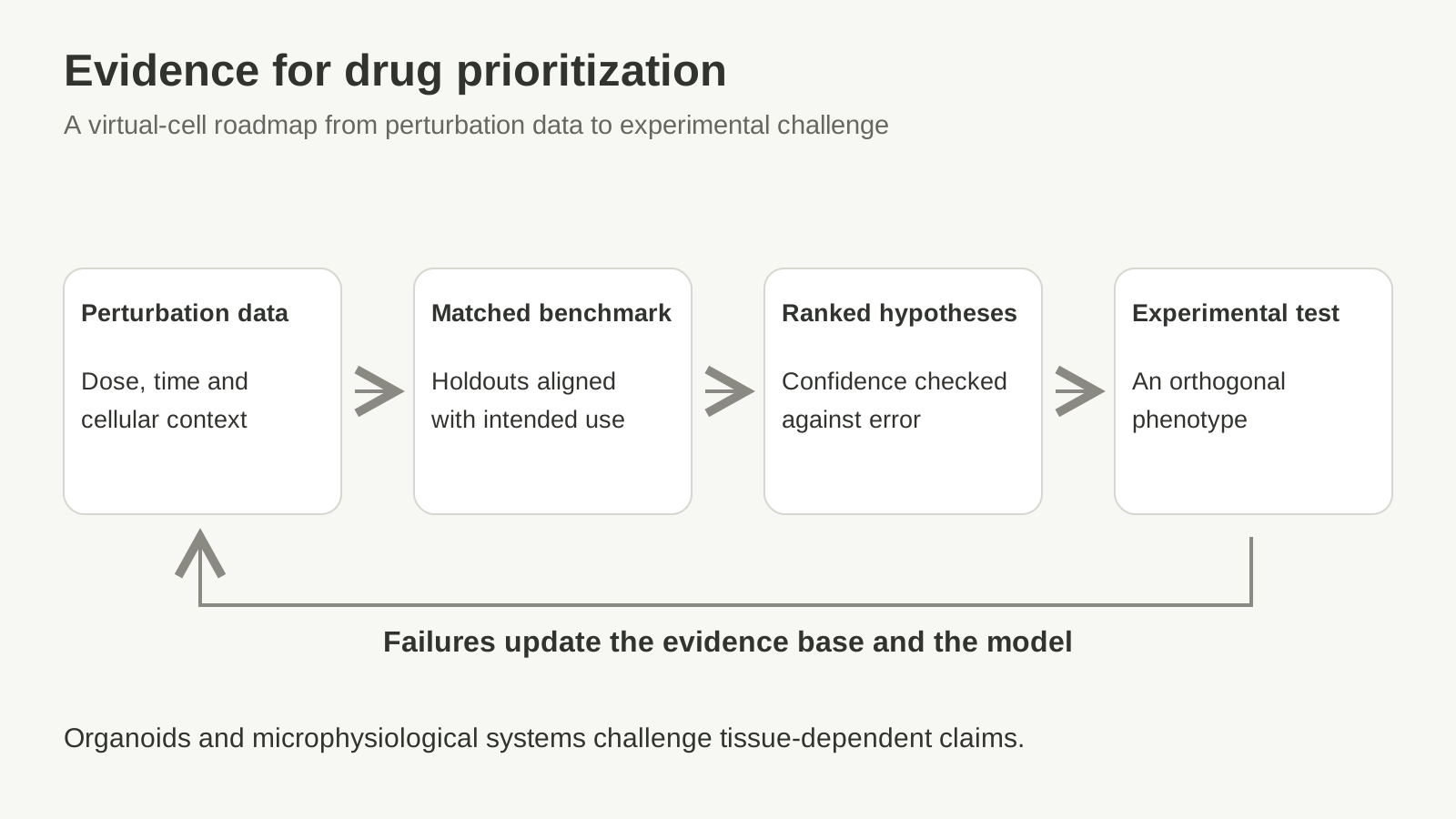
Start with the decision a model is meant to support
A virtual cell may reconstruct a molecular state, predict a perturbation response, trace a trajectory or rank candidate interventions. Those are different tasks with different evidential requirements. A review led by academic and clinical researchers in China argues that virtual-cell research becomes useful for drug prioritization when the connection between data, modeling, benchmarking and experimental validation is explicit.
The authors propose a framework for trustworthy virtual cells rather than a new predictive model. They distinguish a forecast that helps order experiments from one that could independently justify a clinical or development decision. Their near-term applications are target prioritization, mechanism-related drug ranking and selection of doses, combinations or experimental contexts for follow-up.
Five layers describe the available biological support
Perturbation-resolved molecular data form the first layer. Observational cell atlases describe states, but predicting interventions requires information about what changed after a defined perturbation. Dose, duration, starting state, biological replication and batch are part of the target definition. Missing them can make a technical difference resemble a biological response.
A second layer combines modalities such as RNA, protein and chromatin. The review emphasizes partial pairing: some cells have several assays, whereas others contribute only one. Treating those measurements as fully matched can overstate certainty, while discarding incomplete observations wastes available information. The model needs to reflect the actual cross-modal support.
Spatial, temporal, physiological and donor context form a third layer. A cell's neighborhood, developmental history, genotype and disease state can change its response. A fourth layer adds phenotypes measured through another experimental channel, including morphology, viability, protein function or electrophysiology. These can challenge a transcriptomic prediction without simply repeating its training measurement.
Structured biological knowledge supplies the fifth layer. Pathway, interaction and drug–target information can constrain learning and interpretation. The review treats these resources as priors whose contribution should be tested; a familiar pathway label cannot by itself establish an unsupported intervention effect.
Model complexity should follow the task
The review compares mechanistic, generative, foundation and hybrid approaches. Mechanistic models offer explicit assumptions but can be difficult to parameterize at scale. Generative models can forecast defined perturbation responses, while large pretrained representations may transfer useful information across datasets. Hybrid models connect data-driven prediction with structured biological constraints.
The authors do not make the largest architecture the default choice. Linear, nearest-neighbor, factor or compact mechanistic models may be adequate for reconstruction or interpolation within a well-covered system. For a model intended to rank unfamiliar interventions, support, uncertainty and experimental testing become more important than scale alone. The appropriate comparison is therefore tied to the intended biological question.
Hold out what the intended use requires
Randomly withholding individual cells can leave the same perturbation, donor, batch or closely related state in training and testing. Such a design may measure interpolation accurately while providing little evidence for a new compound, laboratory or disease context. The review calls for split families that explicitly match the deployment claim, including perturbation-, donor-, study- and context-level holdouts.
Metrics must also match the output. A global expression correlation can conceal errors in the genes, pathways or rare states that determine the experimental decision. Drug-ranking claims require ranking-related outcomes, and uncertainty should be evaluated against error or retained prediction coverage. Strong simple baselines and ablations help identify whether an apparent advance comes from the proposed component.
The proposed reporting checklist therefore asks what was held out, what support remained, which baseline was hardest to beat, how confidence was calibrated and whether independent or orthogonal evidence was obtained. The review envisages versioned community benchmarks with enough metadata to reproduce those decisions, rather than a single leaderboard score spanning incompatible tasks.
Experimental challenge increases with the claim
The authors describe validation as a sequence of increasingly demanding tests. Internal held-out data may support bounded reconstruction. A proposed cellular regulator or intervention needs direct perturbation testing, and disease-relevant drug prioritization needs further external evidence. Pooled genetic perturbation assays can test cell-intrinsic predictions, while imaging, protein measurements or function can reveal failures invisible to transcriptomic similarity.
For immune interactions, tissue remodeling or contextual drug responses, organoids and microphysiological systems can provide a more demanding experimental setting. Their architecture and multicellular composition allow a model's conclusions to be challenged beyond an isolated cell line. The review does not treat their added complexity as automatic validation; the experimental system must represent the feature relevant to the claim.
Failures should then update the model and its evidence base. An incorrect prediction in one lineage, dose range or tissue context may identify a missing input, an unsuitable prior or a sparsely covered domain. Follow-up experiments can be selected to distinguish those possibilities and improve the next prediction cycle.
Data coverage still limits transfer
Current data remain concentrated in short-term, RNA-based measurements from a limited set of cell lines. Matched perturbation, time, donor and tissue-context data are scarce, and large multimodal models add reproducibility and access costs. The authors therefore apply their framework proportionally: a compact model may be sufficient for a narrow task, while action-oriented claims need calibrated uncertainty and stronger experimental challenge.