
A Virtual-Cell Perspective Proposes Tests for the Value of Mechanistic Equations
A Cells Perspective separates a model’s predictive advantage from evidence that its specified biology supplied that advantage. It proposes a controlled unfolded-protein-response experiment and matched computational comparisons; the design has not been implemented.
A mechanistic model makes an additional claim
Adding biochemical equations to a virtual-cell model can make its structure interpretable, but the predictive value of those equations still needs to be tested. A Perspective by Mikołaj Stańczak and Sarfaraz K. Niazi asks whether biologically specified dynamics improve predictions of unseen drug or genetic perturbations beyond appropriately matched alternatives. The article reviews evidence and proposes a prospective experiment; it reports no new model implementation, biological dataset or performance result.
The authors distinguish a biologically specified operator from dynamics learned from data. Here, an operator is the mathematical description of how a biological state changes or is selected. In the biologically specified case, states and parameters have declared meanings, units or bounds before fitting. A learned dynamical model can also represent time-dependent processes and recover useful structure, but that success alone does not establish the value of a previously specified biochemical mechanism.
Predictive superiority and mechanistic attribution need different comparisons
The Perspective describes an uneven benchmark record. Simple predictors remain competitive in several perturbation tasks, while relational, transport-based and learned-dynamical approaches improve particular settings. Rankings depend on which interventions or contexts are held out, the statistical unit, effect sizes and metrics. These findings concern the named tasks in the reviewed literature, rather than a permanent ranking of model families.
The authors did not identify a study isolating a biologically specified operator against their complete matched-control set under one locked evaluation. They explicitly date this literature claim to their August 2026 recheck. Because selection and extraction were performed by one author without duplicate screening, the article is a critical Perspective rather than a systematic review. An overlooked qualifying study could change the novelty of the proposed test.
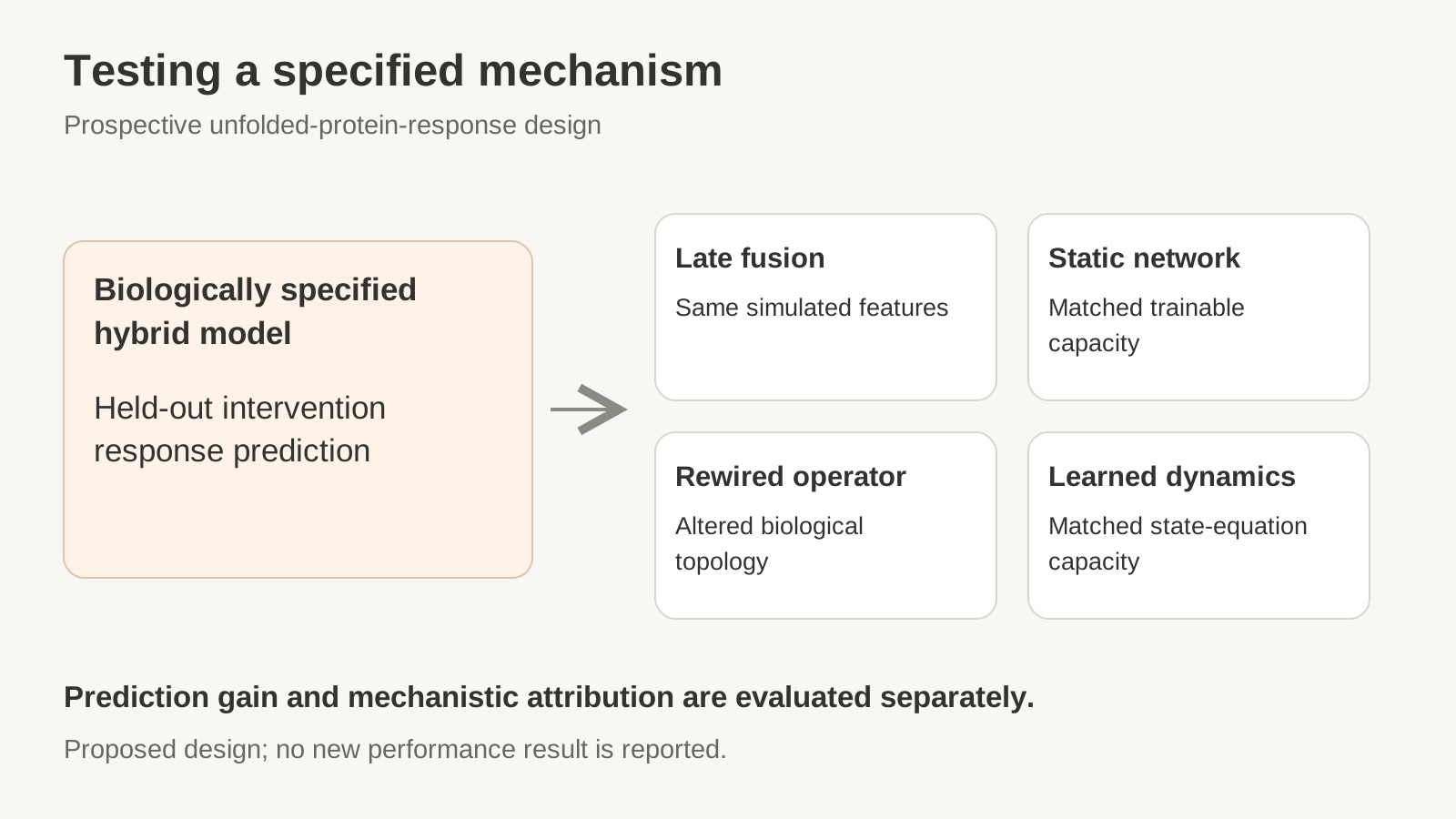
Two analyses follow from the argument. Predictive superiority compares the hybrid model with the strongest compatible general predictor selected on validation data. Mechanistic attribution instead asks whether the declared biology adds value beyond controls designed to isolate that component. The authors call the latter difference “mechanistic predictive gain,” a normalized predictive-score comparison with a design-specific noise floor.
Four controls isolate the proposed source of improvement
The first control combines the same simulated features with the learned representation through late fusion, without tighter gradient coupling. If it performs equally well, the extra coupling has not demonstrated a benefit. A capacity-matched static network tests whether model size, rather than the mechanistic restriction, explains the gain.
An ensemble of rewired mechanisms tests the importance of the declared biological connections. A matched learned-dynamical operator tests whether dynamics help while the specific prior topology contributes little. These comparisons preserve the relevant inputs, observation mapping, intervention knowledge, tuning opportunities and computational budget. The strongest isolation comparator is selected before the test outcomes are opened, with all four controls also assessed together.
The proposed gain is reported alongside parameter identifiability, uncertainty calibration, discrepancy and computing cost. A model could predict well while its rate constants remain weakly identified. Likewise, a flexible discrepancy component could absorb missing biology and make the complete model accurate without validating the stated mechanism.
One pathway provides a bounded experimental test
The proposed biological case is the unfolded protein response, the endoplasmic-reticulum stress system involving PERK, IRE1 and ATF6 signaling. The authors select it because it has defined interactions, interventions with named molecular actions, measurable pathway components and time-dependent feedback. A reduced ten-state equation system describes stress load, sensor activities, adaptive outputs and terminal-stress signaling.
The design separates preliminary work from confirmation. Synthetic recovery would first test whether the proposed quantities can be identified. Direct pathway measurements and a variance pilot would then constrain parameters and determine whether the endpoint has enough predictive headroom. Only after those stages would the group freeze the model, analysis and held-out interventions for a transcriptomic prediction experiment.
The planned primary inference uses interventions and independent cultures as the design units. Additional cells within a well improve estimation of its mean; they do not create additional independent cultures or interventions. Two endpoint times would be chosen by a prespecified rule from observed pathway dynamics, allowing adaptive and terminal stress to be distinguished. Later stages would address a new cellular context and a separate prospective batch.
Failure is part of the proposed decision
None of these stages has been run. The parameter caps, sample sizes, margins and discrepancy thresholds are the authors’ design choices, with feasibility left for the preliminary stages to assess. The proposed protocol could stop before expensive confirmatory experiments if identifiability or power proved inadequate. The article also does not claim that a public registry entry already exists.
For drug research, the Perspective links stronger uses to stronger evidence. Target prioritization would require prospective hit-rate improvement in a relevant experimental system; mechanism assignment would require direct pathway perturbation or rescue; combination selection would need dose-resolved comparisons against an additivity model. Individual digital-twin claims would additionally require longitudinal calibration, uncertainty and demonstrated decision impact.
A positive prediction with no isolated mechanistic gain could still establish a useful predictor within the tested domain. Equal performance from a simpler or rewired control would narrow the biological interpretation rather than erase the predictive result.