Explore early drug-discovery classification errors and descriptor regions needing additional validation.
Model & Design
MoleculeNet BBBP dataset with 1,955 compounds: 1,492 BBB-positive and 463 BBB-negative; RDKit descriptors and fingerprints, with 743 retained features.
Experimental Format
Stratified tenfold baseline cross-validation; separate single-run resampling comparisons for Logistic Regression and Random Forest; Random Forest feature analysis.
Model Components
Component
Structure-based inputs
Description
SMILES-derived molecular fingerprints and physicochemical descriptors; paper describes logBB = −1 as the class threshold.
Component
Class-balancing comparisons
Description
Unbalanced training, SMOTE, Borderline-SMOTE and the approach labeled undersampling; training-only resampling according to the Methods.
Measurements & Endpoints
Accuracy, precision, recall and F1-score
False-positive and false-negative counts
ROC AUC and average precision
Descriptor-dependent label frequencies and classification accuracy
Analysis
Keep positive-class recall distinct from minority-class recognition. Compare tenfold baseline averages separately from the 587-compound single-run tables; interpret feature associations within the training chemical space.
Published Evidence
Study Design
Internal model/resampling comparison and exploratory feature-importance analysis; no external scaffold or prospective compound validation.
Study Sample
1,955 reference compounds; single-run comparison 587 test compounds comprising 448 positive and 139 negative labels.
Comparison
Classifiers, resampling strategies, majority-label baseline and descriptor-defined subgroups.
Finding
Random Forest cross-validation accuracy/F1 = 0.877/0.924. In the single-run table, no resampling versus SMOTE gave accuracy 0.903/0.906 and recall 0.989/0.987. Undersampling reduced false positives 52→42 but increased false negatives 5→20. NH/OH-count-three subgroup accuracy was 67.9%.
Interpretation & Limits
Reference-label prediction is not a new human BBB transport measurement.
External scaffold/generalization validation was proposed rather than performed.
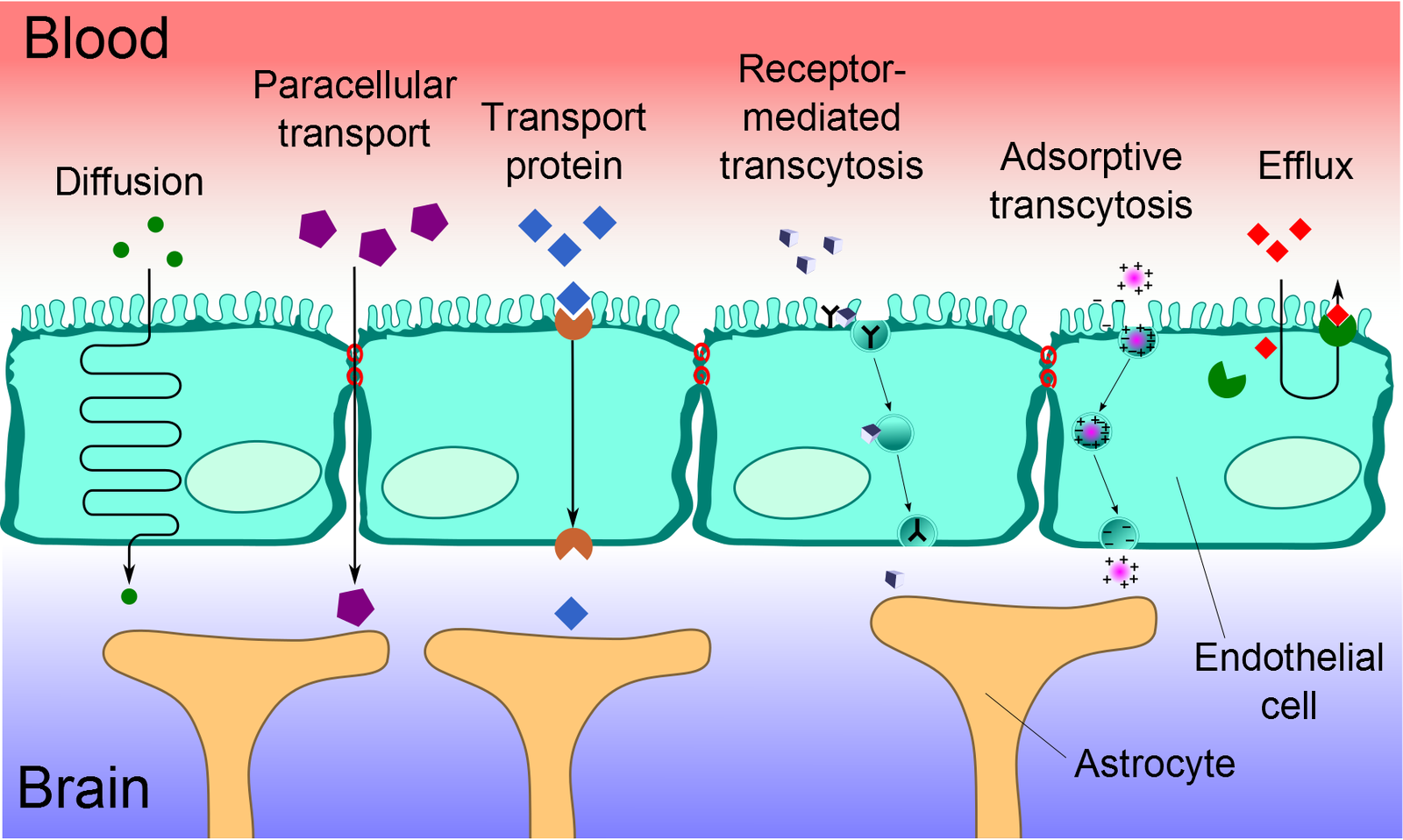
Active transport and multiple ionization states were not modeled.
Resampling gains depend on the metric and error costs.
Feature importance and subgroup associations do not prove a universal causal permeability threshold.
An analysis of 1,955 reference compounds compared molecular-descriptor classifiers and class-balancing methods. Random Forest performance changed modestly with resampling, while errors clustered in some descriptor groups; external chemotype validation and active transport were outside the study.