Drug Uptake Quantification in 3D Blood–Brain Barrier Organoids
A human-cell BBB organoid assay estimates drug concentrations within single organoids from UPLC-MS/MS measurements of their lysates and compares uptake ratios with published in vivo brain-to-plasma data.
Brain & Neural ModelsOrganoids
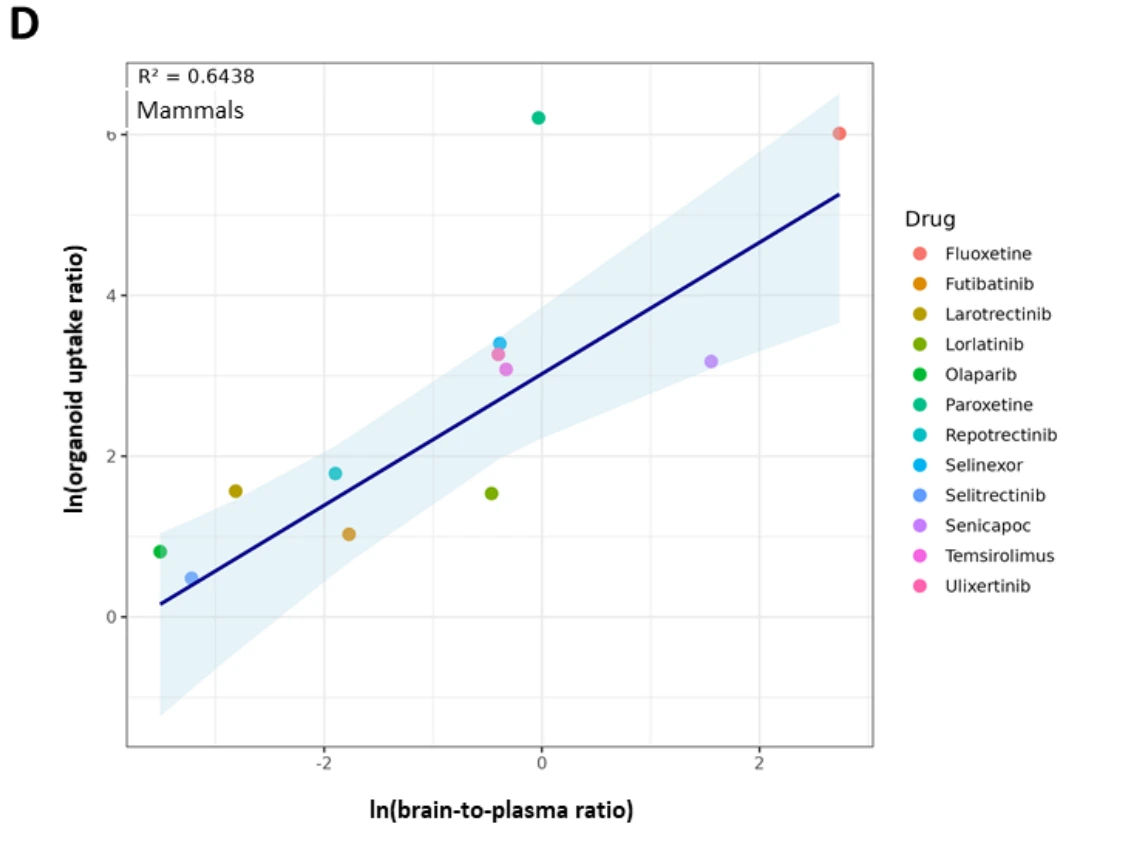
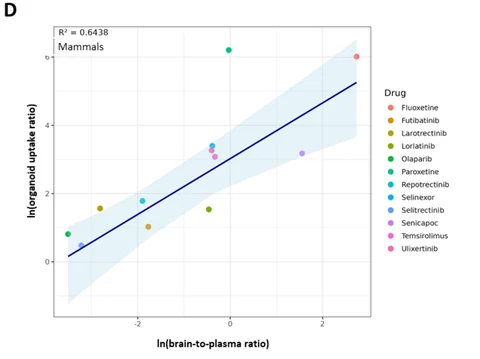
Log-transformed organoid uptake ratios versus published mammalian brain-to-plasma ratios. (Bay et al., Fig. 6D, CC BY 4.0)
Research Applications
Explore whether quantitative uptake in a human-cell barrier model can help rank drugs for brain exposure in early development.
Model & Design
Three-dimensional assemblies of hCMEC/D3 human brain microvascular endothelial cells, primary pericytes and primary astrocytes; main analysis on day 3 after assembly.
Experimental Format
Expose organoids to drugs at defined concentrations and times; quantify drug in individual organoid lysates by UPLC-MS/MS, then estimate the internal concentration using an approximate spherical organoid volume (radius 100 μm). The uptake ratio divides this estimate by the corresponding incubation concentration.
Model Components
Component
Human-cell BBB organoids
Description
hCMEC/D3 endothelial cell line with primary pericytes and astrocytes.
Component
UPLC-MS/MS drug assays
Description
Drug-specific calibration and quality-control samples in organoid matrix.
Measurements & Endpoints
Estimated drug concentration inside individual organoids
Organoid-to-medium uptake ratio at apparent steady state
Association with published brain-to-plasma ratios by Deming regression
ATP viability and LDH cytotoxicity under the tested conditions
Analysis
Thirteen drugs were measured. Conditions entered downstream analysis when at least seven individual organoids from two preparations were quantifiable; uptake experiments were repeated independently three times. For correlation, mean uptake ratios based on at least 10 organoids were compared with published in vivo ratios after log transformation. Octreotide at background level was excluded from the logarithmic regression.
Published Evidence
Study Design
Compare measurable drug uptake ratios with heterogeneous published mammalian, primate and human brain-to-plasma data.
Study Sample
Thirteen drugs tested; 12 had measurable concentrations usable for the main correlation. Available drug subsets differ in primate and human analyses.
Comparison
Literature brain-to-plasma or related unbound brain/CSF-to-plasma ratios, not a prospective patient cohort.
Finding
Combined mammalian Deming regression pseudo-R² 0.64; primate and human subsets 0.81 and 0.82. Four in silico comparators showed no correlation with this reference set in this study.
Interpretation & Limits
Different species, matrices, disease states and sampling times in reference literature.
Subgroup regressions use different drug subsets and are not directly comparable.
Between-organoid variation and absent blood flow limit physiologic extrapolation.
Unreviewed preprint; no regulatory qualification claimed.
A Research Square preprint quantified uptake of 13 drugs in human-cell blood–brain barrier organoids. For measurable drugs, organoid uptake ratios correlated with published mammalian brain-to-plasma data, although the reference data and organoids themselves varied.