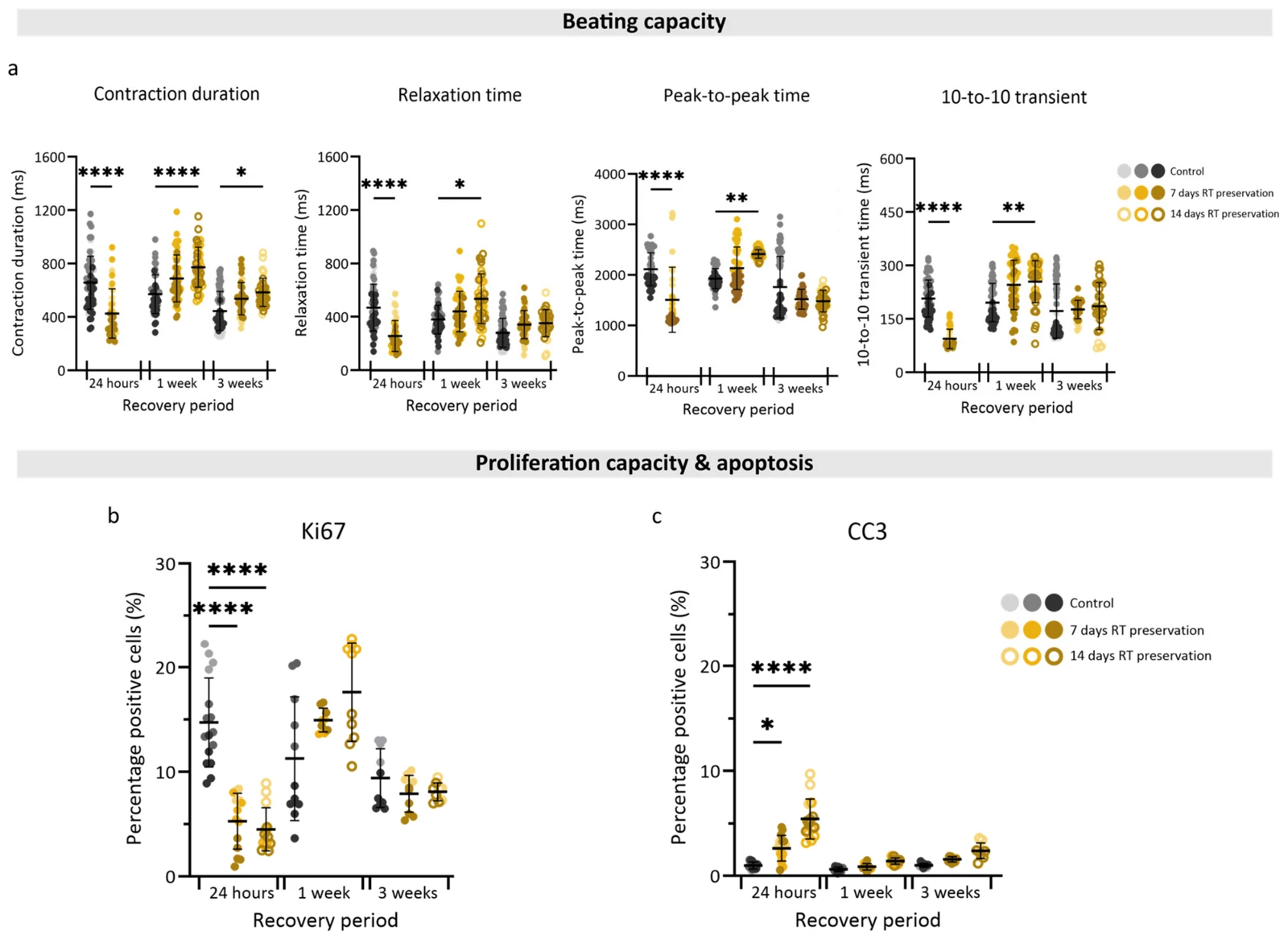
Characterization of model handling and tissue-quality recovery before subsequent cardiac research.
Model & Design
Cardiac organoids from one hiPSC line, selected after initial comparison with immortalized-cell cardiac spheroids.
Experimental Format
Short-term room-temperature transport-medium storage versus slow-freezing, followed by standard culture and serial recovery measurements.
Model Components
Component
Human tissue
Description
Single-line hiPSC-derived cardiac organoids with unpreserved controls.
Component
Preservation conditions
Description
CellShip room-temperature medium and CryoStor CS10 slow-freezing, each tested over 7 or 14 days.
Component
Measurements
Description
ATP, size, Ki67/cleaved-caspase-3 and contraction timing, including beat-rate-normalized analysis.
Measurements & Endpoints
ATP-associated viability
Diameter
Proliferation/apoptosis markers
Contraction, relaxation and beat interval
Analysis
Evaluate each endpoint over recovery time. Raw and frequency-normalized contraction parameters need separate interpretation.
Published Evidence
Study Design
Compare matched short preservation durations and several recovery intervals with unpreserved tissue.
Study Sample
One hiPSC background; figures report two to three biological replicates, with organoid-level sampling inside each experiment.
Comparison
Unpreserved cultures sampled at the stated recovery-associated time points, and the alternative preservation condition.
Finding
Seven-day ambient storage supported earlier beating recovery and retained ATP; longer storage delayed recovery. Some morphology and frequency-normalized timing changes persisted or appeared later.
Interpretation & Limits
The experiment addresses short-term storage rather than months-to-years banking.
Container/gas-exchange scaling was not systematically evaluated.
Post-storage pharmacological panel performance was not assessed.
An academic preservation study compared short-term ambient storage with slow-freezing in human cardiac organoids. Room-temperature cultures retained ATP-associated viability, but recovery time and storage duration affected their contraction and injury measurements.