
Cardiac Organoids Recover Beating after Seven Days of Room-Temperature Storage
An academic preservation study compared short-term ambient storage with slow-freezing in human cardiac organoids. Room-temperature cultures retained ATP-associated viability, but recovery time and storage duration affected their contraction and injury measurements.
Testing Tissue Quality after Storage
Researchers at the Belgian Nuclear Research Centre, KU Leuven and collaborating universities evaluated storage conditions for human cardiac organoids. The study addresses a practical requirement for advanced cell models: tissues need to retain measurable biological properties when stored or transported between experimental steps or laboratories.
The investigators first compared immortalized-cell cardiac spheroids with induced pluripotent stem cell-derived organoids. The spheroids lost viability-associated measures during culture, whereas the organoids grew and maintained beating. The organoid model was therefore used for the main preservation comparison, combining ATP, tissue size, proliferation, apoptotic staining and contraction measurements.
The organoids came from one hiPSC line. Cultures were preserved for 7 or 14 days either through slow-freezing with CryoStor CS10 or at room temperature in CellShip transport medium. Recovery took place under standard culture conditions, with observations at 24 hours and longer intervals. These matched short storage periods support a comparison of short-term performance.
Slow-Freezing Alters Several Tissue Properties
After cryopreservation, organoids were smaller and showed lower ATP measurements than unpreserved controls. Their beating was absent after 24 hours of recovery, and later contractions had altered timing. Increased cleaved-caspase-3 staining and lower Ki67-positive fractions supplied additional evidence of injury and reduced proliferation.
The functional changes persisted in analyses that normalized contraction parameters to beating frequency. This matters because a faster or slower beat rate can otherwise account for part of the apparent difference in contraction or relaxation duration. The study examined both raw timing measurements and their relation to the beat interval.
Seven and fourteen days of freezing produced broadly similar adverse effects in the reported comparisons. The experiment evaluates this preservation procedure for these organoids over the stated intervals; it does not compare every available freezing formulation or optimized tissue-specific approach.
Ambient Storage Preserves Some Measurements Better than Others
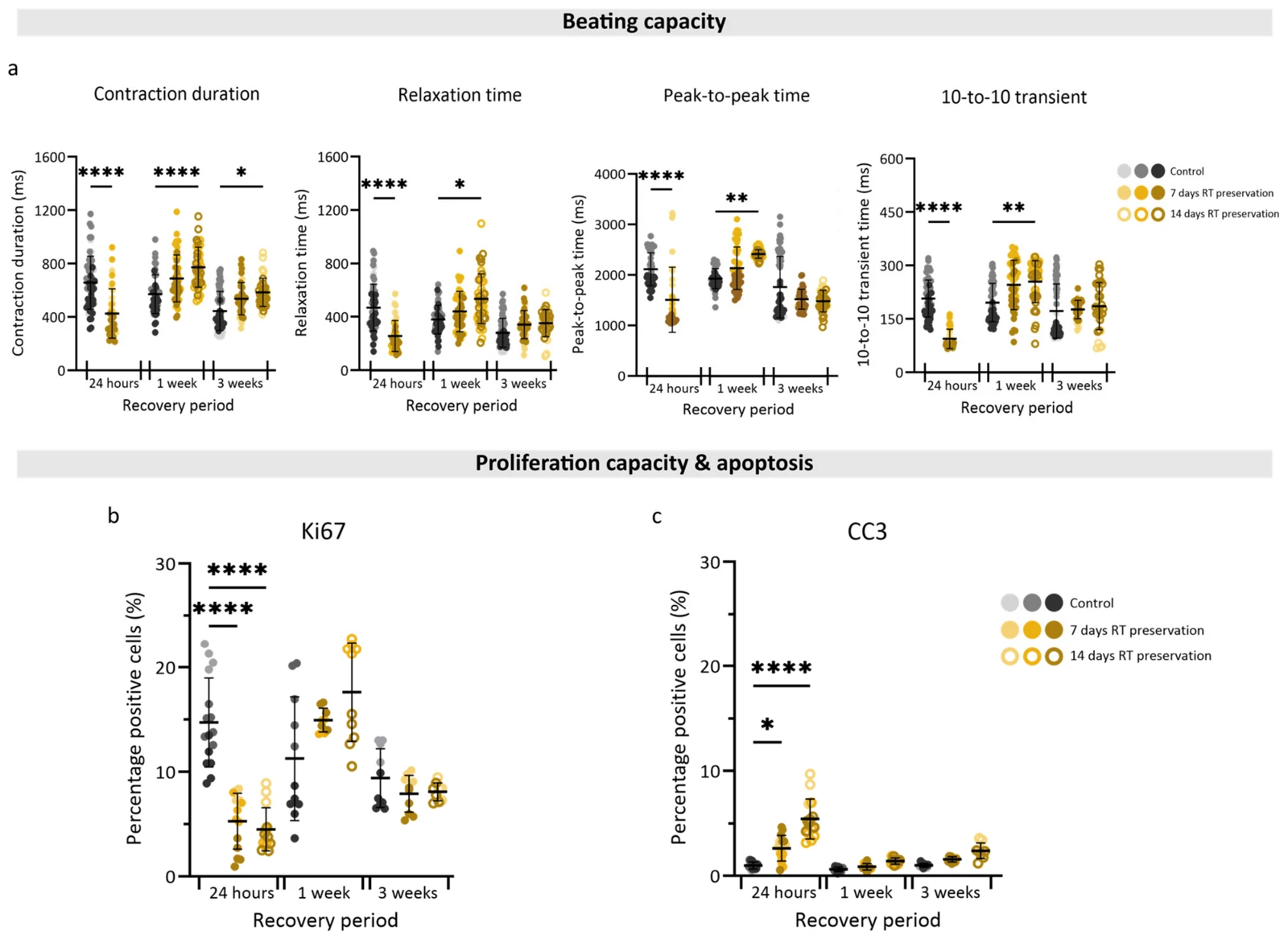
Room-temperature preservation maintained ATP measurements without significant differences from controls during recovery. Tissue size nevertheless decreased in selected storage/recovery comparisons. Preserved metabolic signal therefore coexisted with structural change, making the combination of endpoints informative.
After seven days of room-temperature storage, organoids were already beating at the first recovery observation, although contraction, relaxation and beat-interval parameters initially differed from controls. These measures moved toward control values during recovery, with broadly comparable beating after one week. Frequency-normalized analysis changed which timing differences were significant and also detected later changes during recovery.
Fourteen-day storage delayed recovery. Beating was not measurable at the early observation, and several timing parameters remained altered after one week. By three weeks, most had recovered, while contraction duration was still longer than in controls. At 24 hours, proliferation was lower and apoptotic staining was higher than in controls; these measurements moved back toward control levels during recovery.
A Preservation Result Relevant to Model Handling
The work shows why recovery time belongs in the characterization of a transported or stored tissue model. ATP, morphology and beating did not all return on the same schedule. A culture suitable for one measurement immediately after recovery may still differ from its baseline for another.
The authors identify the single cell line, limited endpoint set and static microplate storage arrangement as constraints. Container geometry, gas exchange and tissue-to-medium ratio were not systematically varied. They also distinguish short-term storage from the months-to-years purpose of conventional cryopreservation.
For NAMs-based drug research, the study supplies model-quality evidence about maintaining a functional cardiac preparation during handling. It does not test a drug panel after transport or establish that stored and fresh organoids have identical pharmacological responses. Those comparisons would extend the practical preservation findings into assay-performance evidence.