Compare DR5-targeting Oba01 and CDK inhibition in organoids derived from colorectal xenografts, with linked cell-line and mouse experiments.
Tumor ModelsOrganoids
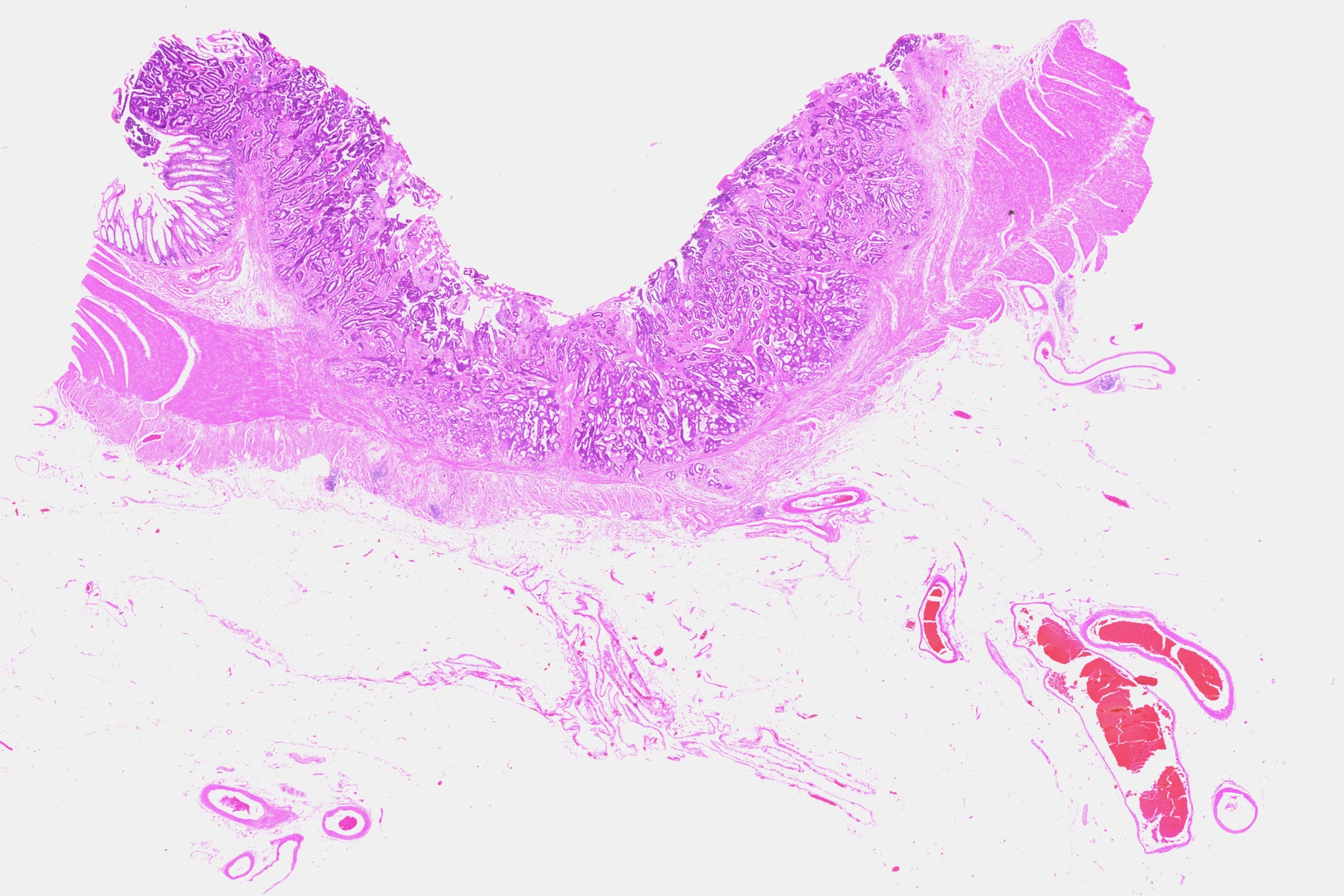
Whole-mount histological scan of colon adenocarcinoma. (Ed Uthman, CC BY 2.0)
Research Applications
Prioritize ADC combinations and identify model-dependent response or mechanistic discrepancies.
Model & Design
Four organoids derived from colorectal PDXs: MSS CRC082/CRC196 and MSI-H CRC090/CRC114. The wider ten-PDX panel contains eight MSS and two MSI-H models.
Experimental Format
Two-day pre-culture followed by six-day live-image response analysis; Oba01 50 μg/mL plus abemaciclib 200 nM. The separate Notch-addition comparison includes FLI-06 at 2 μM. Cell-line viability and interaction assays use 72 hours and distinct dose pairs.
Model Components
Component
Model characterization
Description
Xenograft-derived tumor cultures in extracellular-matrix droplets; H&E, CK-pan, CK20, CDX2, β-catenin, DR5/CDK4 staining and exome comparisons.
Component
Response and mechanism
Description
IncuCyte growth monitoring; CellTiter-Glo for cell lines; proteomics and cell-line RNA sequencing; CDK4 knockdown; single-agent, combination and FLI-06 conditions.
Measurements & Endpoints
Organoid growth over 144 hours
Cell-line viability and interaction coefficient
Proliferation/apoptosis
Protein/pathway changes
Separate PDX tumor-growth response
Analysis
Keep cell-line interaction calculations separate from organoid growth suppression. Interpret culture/mouse response differences without assuming measured drug disposition.
Published Evidence
Study Sample
Four PDX-derived organoid models, two MSS and two MSI-H. The source reports at least three experiments unless otherwise specified. Combination xenograft groups contain four to six mice, distinct from the ten-model monotherapy panel.
Comparison
Vehicle, unconjugated zaptuzumab, free MMAE, Oba01, CDK inhibitor and combination; addition of FLI-06; paired PDX and organoid responses.
Finding
Oba01 plus 200 nM abemaciclib suppressed growth more than either agent alone in all four organoid models. Strong CRC090 mouse efficacy was weaker in the paired organoid. FLI-06 did not enhance the combination. In the separate CRC082 xenograft, growth inhibition was 68.25% with the combination versus 27.55% for Oba01 and 34.10% for abemaciclib.
Interpretation & Limits
Organoids pass through PDX establishment and lack intact human immunity.
Four-model organoid panel; no prospective patient combination-response validation.
The culture-exposure explanation for CRC090 is proposed rather than directly measured.
Notch enrichment was not confirmed as a sufficient therapeutic mechanism; some xenografts later recurred.
Study Design
Primary study comparisons of the named models, exposures and measured outcomes.
Four colorectal xenograft-derived organoid models showed greater growth suppression with Oba01 plus abemaciclib than with either drug alone. Cell-line and mouse studies support the combination, while unequal model responses and a negative Notch perturbation limit the mechanistic interpretation.