
Colorectal Xenograft-Derived Organoids Test a DR5 ADC–CDK4/6 Inhibitor Combination
Four colorectal xenograft-derived organoid models showed greater growth suppression with Oba01 plus abemaciclib than with either drug alone. Cell-line and mouse studies support the combination, while unequal model responses and a negative Notch perturbation limit the mechanistic interpretation.
A Drug-Combination Study Across Linked Models
A study led by Gannan Medical University researchers and collaborators, including Yantai Obioadc, tested Oba01 with cyclin-dependent kinase inhibitors in colorectal cancer. Oba01 is an antibody–drug conjugate (ADC) targeting death receptor 5 (DR5) that delivers the microtubule-disrupting payload monomethyl auristatin E, or MMAE. The research combines cell lines, patient-derived xenografts and organoids derived from those xenografts to investigate a treatment combination.
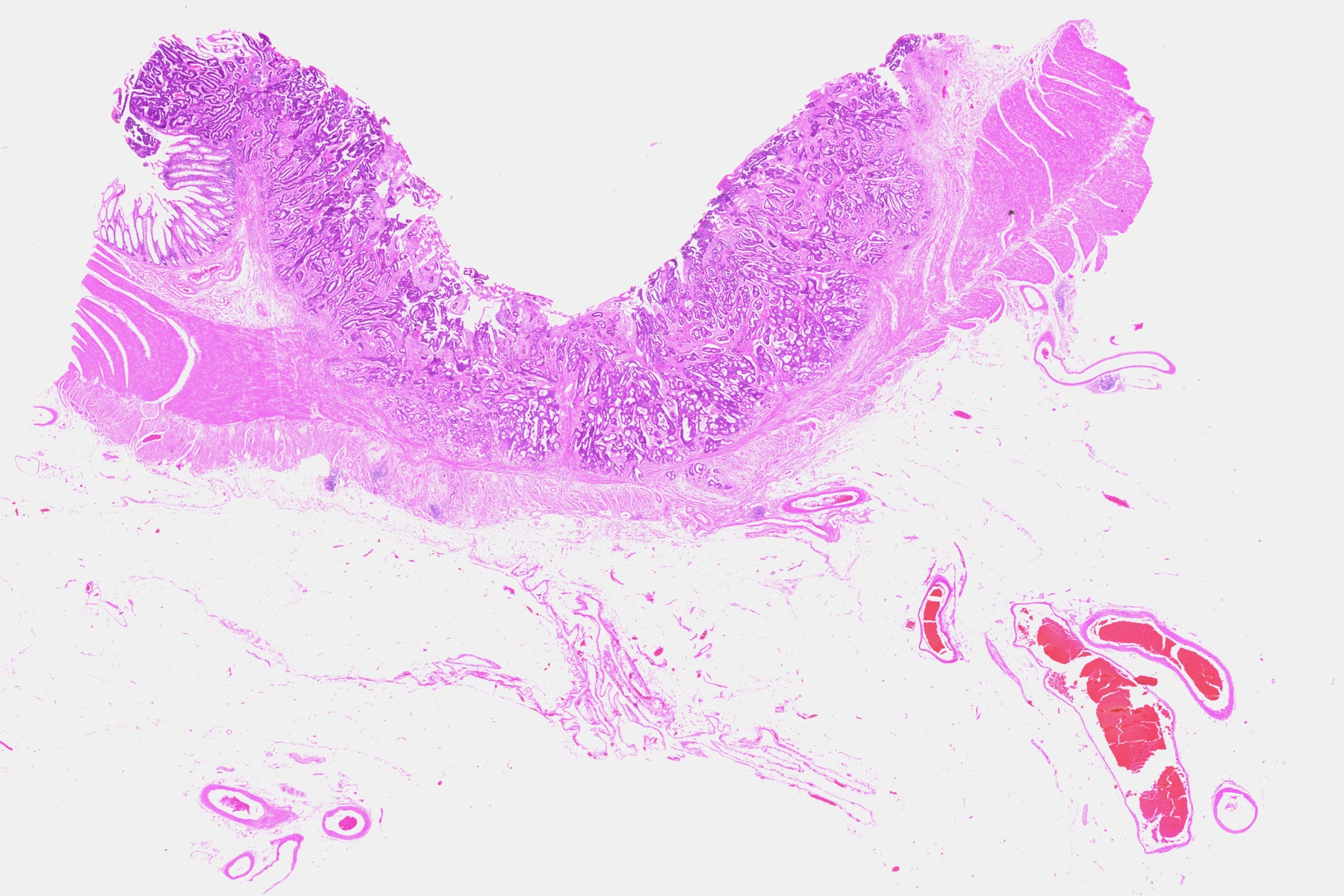
The team established ten xenograft models: eight microsatellite-stable and two microsatellite-instability-high tumors. Histology, marker staining and exome sequencing supported preservation of many source-tumor features after mouse passage. The organoids were subsequently grown from xenograft tissue, so their derivation includes that animal-selection step.
DR5 assessment used a separate expression dataset of 367 patients and an immunohistochemical cohort of 509 patients. These analyses supported a target present across both microsatellite groups, but target expression alone was not the drug-response test. Four DR5-positive cell lines responded to Oba01, with substantially weaker effects from the unconjugated antibody and strong effects from free MMAE under the tested conditions.
Cell-line Oba01 IC50 estimates ranged from 1.92 to 21.51 nM across the four models. The organoid combination used a different concentration and longer observation period; those stages should be interpreted as separate pharmacological comparisons rather than interchangeable potency measurements.
CDK Inhibition Emerges from Profiling and Perturbation
RNA sequencing of four treated xenografts highlighted changes in cell-cycle programs. CDK4 knockdown increased Oba01 sensitivity in two cell lines, supplying functional support beyond pathway enrichment. A screen of 48 CDK inhibitors identified 21 with growth-inhibitory activity in the tested cell-line panel, and abemaciclib was selected for detailed combination testing.
Combination activity depended on dose and cell line. The study used viability assays, live-cell confluence imaging, proliferation measurements and apoptosis assays to distinguish these effects. Changes in ERK, AKT, retinoblastoma-protein and other signaling measurements also varied between models; the results do not define a single uniform molecular sequence for every colorectal tumor.
Four Organoid Models Show Increased Growth Suppression
Two microsatellite-stable and two microsatellite-instability-high xenograft-derived organoid models were assessed by live imaging. After two days of culture, organoids received treatment for six days. Oba01 at 50 μg/mL plus abemaciclib at 200 nM suppressed growth more than either agent alone across the four models over the 144-hour observation period.
The paired models also exposed a discrepancy relevant to interpretation. CRC090 responded strongly to Oba01 in the mouse, while its corresponding organoid showed weaker activity. The authors proposed that large-molecule exposure in culture could contribute, but this experiment did not directly measure drug transport or pharmacokinetics. Model agreement therefore cannot be assumed solely from shared tumor origin.
Proteomic analysis linked the combination to reduced Notch-pathway signals. Adding the pan-Notch inhibitor FLI-06 at 2 μM did not further enhance the combination’s tumor-killing activity. That negative perturbation limits an interpretation in which reduced Notch signaling is, by itself, the demonstrated explanation for the combination effect.
Mouse Results Support Further Testing with Model-Specific Limits
Four xenograft models were used for the combination comparison. In CRC082, the reported tumor-growth inhibition was 68.25% with the combination, compared with 27.55% for Oba01 and 34.10% for abemaciclib alone. Other models also showed improved suppression, but strong monotherapy activity in CRC054 made the added interaction difficult to resolve. The study used four to six mice per treatment condition across these models.
Body-weight monitoring and sampled-organ histology did not reveal apparent additional toxicity under the tested schedules. These observations have a narrower scope than a comprehensive safety evaluation. The authors also report later recurrence in some xenografts, a small model panel relative to colorectal-cancer heterogeneity and testing of only one ADC payload class.
The linked organoid and xenograft experiments support a candidate drug-combination strategy and provide a way to compare response across experimental settings. They do not establish patient benefit or validate the organoid assay as a prospective predictor of combination response. The weaker CRC090 organoid effect and the unsuccessful Notch addition are useful findings for deciding which mechanisms and exposure questions require further testing.