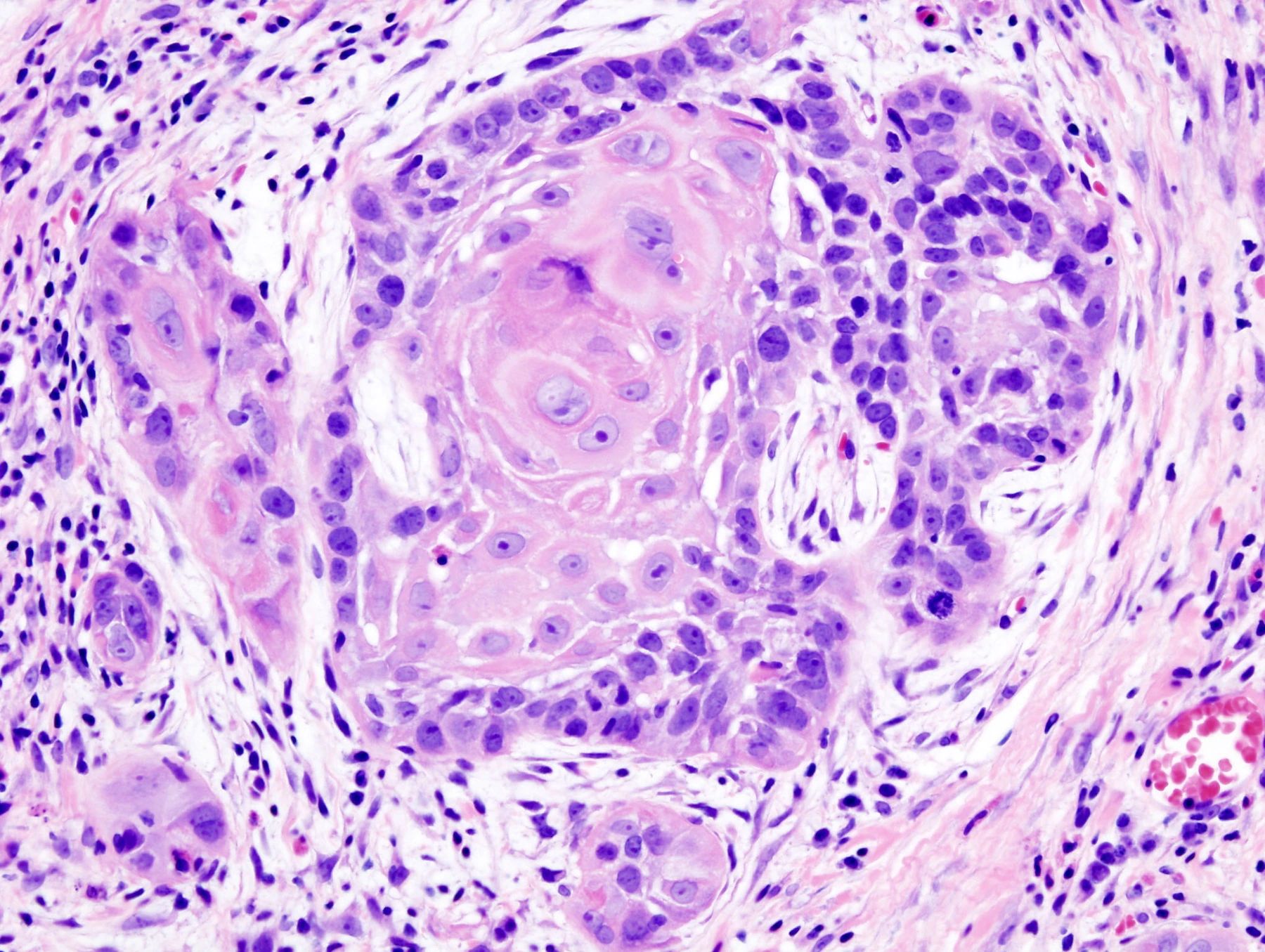
H&E-stained oral squamous cell carcinoma tissue. (KGH , CC BY-SA 3.0 ) Research Applications Preclinical comparison of a repurposed drug with radiation and immune checkpoint blockade in a human-derived tumor model.
Model & Design Patient-derived HNSCC organoids with the T-cell response system reported in the original study.
Model Components Component Tumor model
Description Patient-derived three-dimensional head and neck squamous cell carcinoma organoids.
Component Interventions
Description Atovaquone, radiation and PD-1 or PD-L1 checkpoint blockade.
Measurements & Endpoints CD8-positive T-cell activation Killing of tumor organoids Analysis Relate the measured T-cell activation to organoid killing; retain the mouse tumor-growth evidence as a separate model layer.
Published Evidence Study Design Patient-derived organoid evaluation of the triple combination.
Study Sample Patient-derived head and neck squamous cell carcinoma organoid models.
Comparison The treatment conditions and references reported by the investigators.
Finding The combination increased CD8-positive T-cell activation and tumor killing.
Interpretation & Limits The 6/12 complete tumor eradications were measured in MOCL1 mice, not in the patient-derived organoids.