Method Profile

Kidney Injury and Secondary Cardiac Responses in Human Tissue Co-culture

Previously injured kidney organoids are paired with cardiac microtissues to measure secondary viability, functional, vascular and expression changes.

Multiple OrgansEngineered Human Tissues
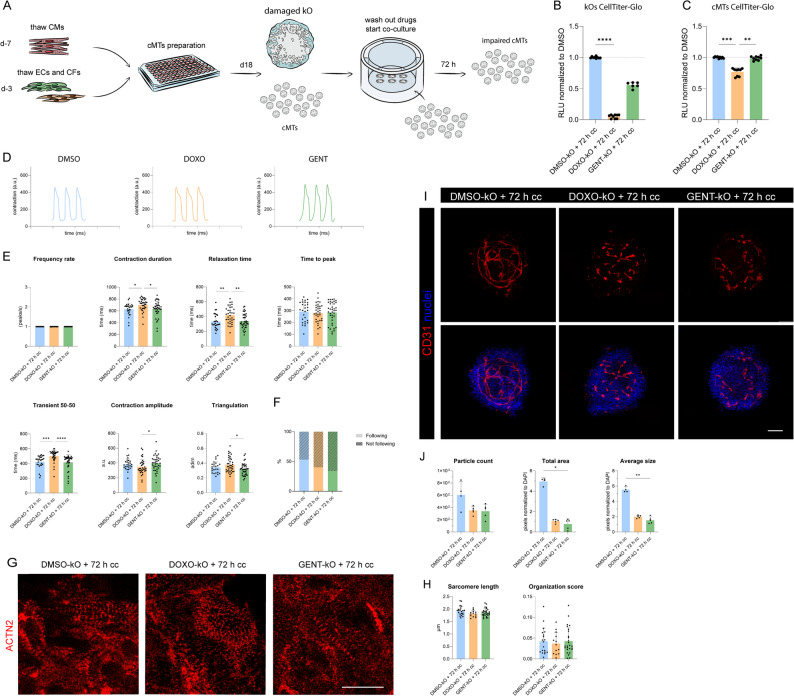
Study diagrams and measurements comparing cardiac microtissues after control, doxorubicin-injured and gentamicin-injured kidney co-culture.
Cardiac microtissue viability, contraction and endothelial structures after co-culture with injured kidney organoids. (Beatrice Gabbin et al. / Cell Communication and Signaling : CCS, 2026, Fig. 2, CC BY 4.0)

Research Applications

Investigation of kidney-to-heart injury propagation and candidate mediators in a controlled human model.

Model & Design

Human iPSC-derived kidney organoids and cardiac microtissues containing cardiomyocytes, fibroblasts and endothelial cells.

Experimental Format

Kidney injury induction followed by washing and static 72-hour co-culture; tissues are measured separately.

Model Components

  • Component

    Human tissue systems

    Description

    Kidney organoids and cardiac microtissues generated independently; doxorubicin and gentamicin produce distinct initiating injuries.

  • Component

    Measurements

    Description

    ATP/LDH, 1 Hz-paced motion analysis, CD31/sarcomere staining and tissue-specific RNA sequencing.

Measurements & Endpoints

  • Tissue viability
  • Pacing response
  • Contraction/relaxation timing
  • Endothelial structures
  • Tissue-specific differential expression

Analysis

Report the fraction of nonresponding cardiac tissues separately from contraction parameters calculated in pacing responders.

Published Evidence

  • Study Design

    Compare cardiac tissues after co-culture with control, doxorubicin-injured or gentamicin-injured kidney organoids.

    Study Sample

    Limited stem-cell backgrounds; RNA comparisons used four biological replicates per tissue/condition, while imaging/function sampling varied by endpoint.

    Comparison

    Control-kidney co-culture, separate cardiac culture and direct-drug reference experiments.

    Finding

    Doxorubicin-injured kidneys produced stronger cardiac viability, functional and endothelial changes; gentamicin had a weaker secondary effect.

    Interpretation & Limits
    • The static short-term model lacks circulation and clearance.
    • Drug carryover was not quantitatively excluded.
    • Causal mediators require additional targeted experiments; tissue/technical replicate counts are not donor counts.

Sources

  1. In vitro modeling of renal injury-induced cardiac effects using human iPSC-derived organoids. Cell Communication and Signaling : CCS (2026). ↗