Paired LLC-PK1-MOCK/MDR1 Transport with Rat Brain-Exposure Correlation
Compare porcine renal epithelial control and human-MDR1-expressing monolayers, relate directional permeability to rat unbound brain exposure, and retest low-recovery outliers separately.
Brain & Neural ModelsEpithelial Barrier Models
Paired porcine epithelial transport assays link to a rat exposure comparison; the four outlier corrections follow the initial held-out test. (NAMs Insights)
Research Applications
Early small-molecule brain-exposure screening focused on passive permeability, P-glycoprotein efflux and intracellular retention.
Model & Design
Immortalized porcine LLC-PK1 cells with empty vector or stably expressed human MDR1; 41-drug panel and rat reference outcomes.
Experimental Format
Control transport on day 4 and MDR1 transport on day 7; 2 μM substrate for 2 hours; permeability in both directions, efflux ratio and recovery; follow-up 1 μM bafilomycin A1 for four low-recovery drugs.
Model Components
Component
Cells and controls
Description
University of Washington-gifted LLC-PK1-MOCK/MDR1 lines; atenolol, metoprolol, digoxin, leakage marker and tariquidar transporter inhibition.
Component
Reference and correction data
Description
Rat brain/plasma distribution from 32 published/internal compounds and 9 new experiments; binding-adjusted unbound ratios, with a 1% free-fraction assignment for binding above 99%; four outlier correction experiments.
Measurements & Endpoints
Directional apparent permeability
Efflux ratio
Mass recovery and intracellular accumulation
Electrical resistance/leakage
Rat Kp,uu,brain prediction error
Analysis
Train on 20 drugs and retain the initial 21-drug result before low-recovery retesting. Treat bafilomycin correction as a separate mechanistic intervention that also affects efflux.
Published Evidence
Study Design
Correlate 20-drug permeability with rat unbound brain distribution, then assess 21 further drugs and separately correct four observed outliers.
Study Sample
41 drugs; 20 development and 21 held-out; transport table n = 3 assay replicates; new rat data for 9 compounds.
Comparison
MOCK versus human-MDR1 line; transporter inhibitor controls; untreated versus lysosomal-inhibited outlier transport; rat binding-adjusted exposure.
Finding
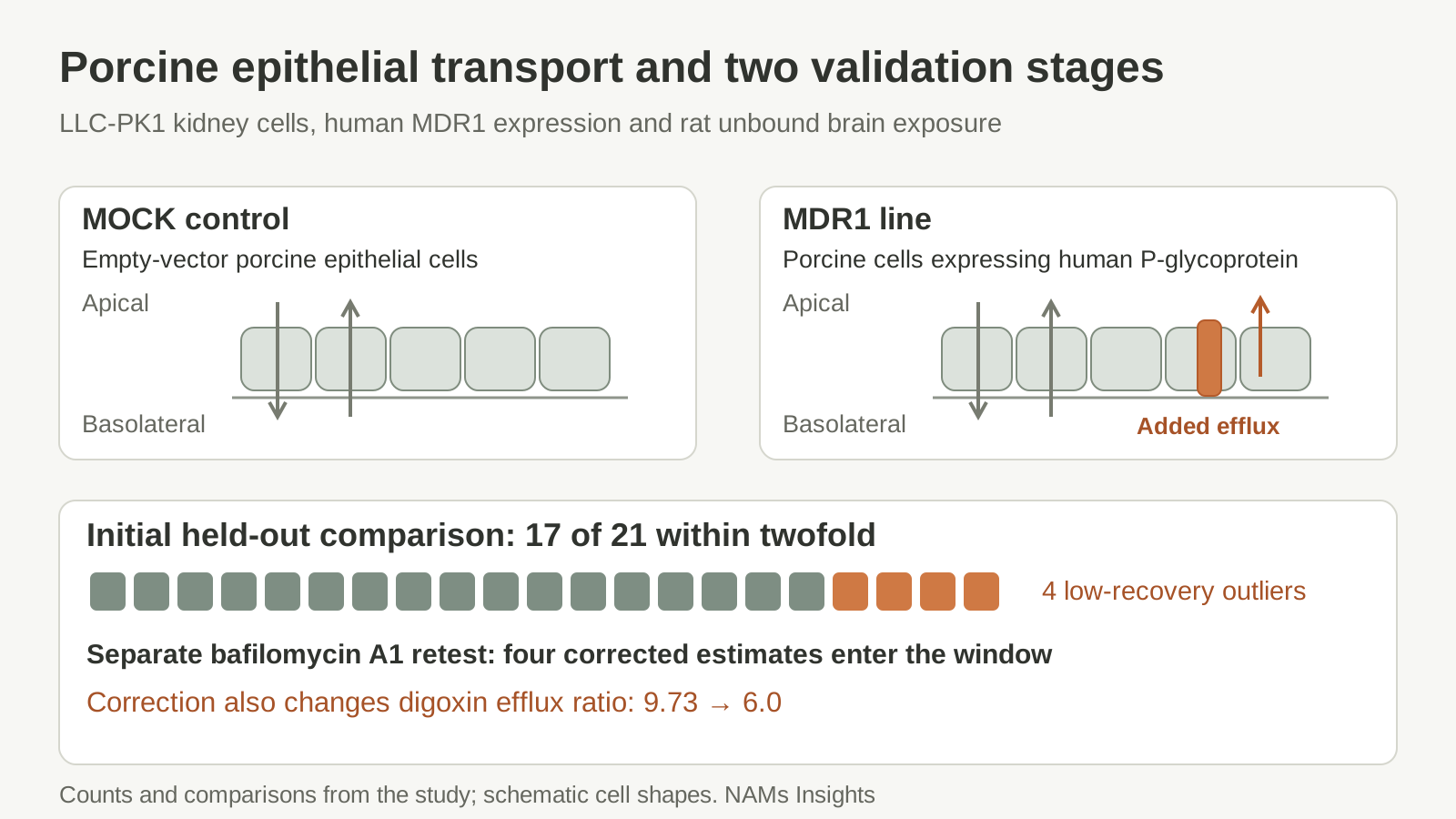
Development R = 0.5984 for MOCK and 0.8886 for MDR1. Initial held-out agreement: 17/21 within twofold; four bafilomycin-retested estimates subsequently entered the window. Digoxin efflux ratio changed from 9.73 to 6.0, revealing a correction-associated transporter effect.
Interpretation & Limits
Porcine renal epithelium differs from human or rat brain endothelium.
Rat exposure reference combines heterogeneous published/internal/new measurements and binding assumptions.
Post-hoc corrected outcomes are distinct from the initial held-out comparison.
Other transporters, cell-free binding, neurovascular cell interactions and biologic-drug transport remain incompletely represented.
A paired LLC-PK1 assay compared passive transport with human MDR1-mediated efflux. Seventeen of 21 held-out drug estimates initially fell within twofold of rat unbound brain exposure; four low-recovery compounds required a subsequent lysosomal-inhibition experiment.