
Porcine Kidney-Cell Barriers Link Drug Transport to Rat Brain Exposure, with Four Post-Hoc Corrections
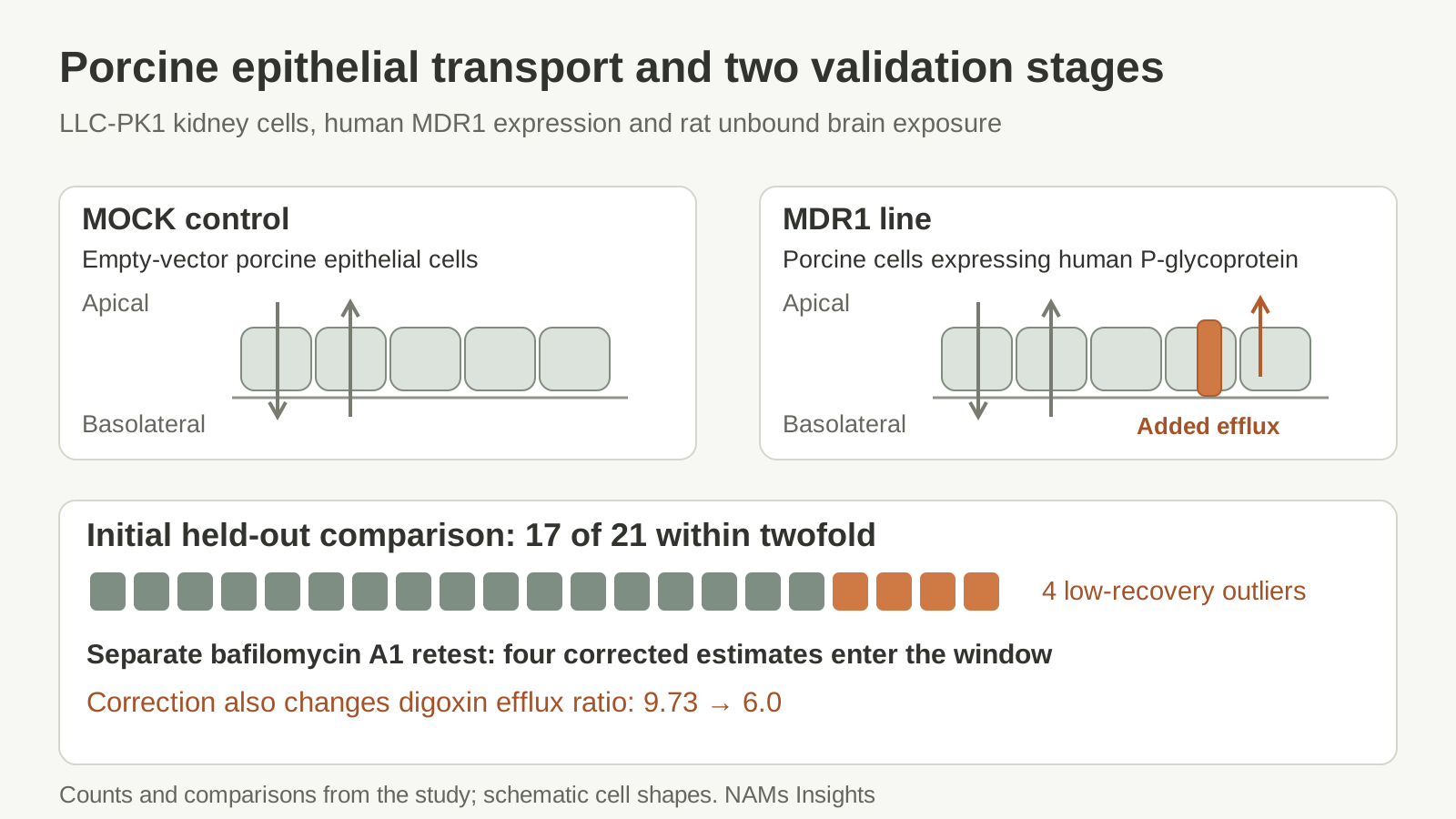
A paired LLC-PK1 assay compared passive transport with human MDR1-mediated efflux. Seventeen of 21 held-out drug estimates initially fell within twofold of rat unbound brain exposure; four low-recovery compounds required a subsequent lysosomal-inhibition experiment.
A Kidney-Epithelial Surrogate for a Brain-Exposure Question
A Drug Delivery study from the Beijing Institute of Pharmacology and Toxicology evaluates a simplified barrier assay for early central-nervous-system drug screening. The model uses LLC-PK1 cells, an immortalized porcine kidney epithelial line, rather than brain endothelial cells. Its purpose is to separate passive permeability, transporter-mediated efflux and intracellular drug retention before relating the measurements to brain exposure.
The investigators compared an empty-vector control line, LLC-PK1-MOCK, with cells stably expressing human MDR1. MDR1 encodes P-glycoprotein, an efflux transporter that can restrict drug entry into the brain. Both cell lines formed monolayers on permeable inserts, allowing transport to be measured in apical-to-basolateral and reverse directions.
Barrier properties developed on different schedules: transport was tested on day four for the control cells and day seven for the MDR1 cells. Electrical resistance at those experimental time points was 132 ± 15 and 89 ± 11 Ω·cm², respectively. A fluorescent leakage marker and reference drugs provided complementary checks because electrical resistance alone did not describe every aspect of solute transport.
Transport Controls Establish the Added Efflux Function
Digoxin provided a functional test of P-glycoprotein activity. Its efflux ratio—the reverse-direction permeability divided by forward-direction permeability—was 0.89 ± 0.04 in control cells and 11.52 ± 1.34 in MDR1 cells. The P-glycoprotein inhibitor tariquidar reduced the MDR1 ratio to about 0.99, while the control line changed little. This supports an added directional transport function in the engineered model.
The team then measured 41 drugs at 2 μM over two hours, with three assay replicates reported in the transport table. Permeability and efflux varied substantially across the panel. Comparing the two cell lines helped identify compounds whose apparent permeability was restricted by the added transporter, while mass-recovery measurements identified a different source of assay error.
Amitriptyline, paroxetine, sunitinib and tetrandrine had recoveries below 80%. Recovering drug from lysed cells increased the measured totals, implicating intracellular accumulation. The study also acknowledged that membrane or plastic binding could contribute because dedicated cell-free binding experiments were absent.
The Initial Held-Out Comparison Has Four Outliers
The reference outcome was the unbound brain-to-plasma distribution ratio in rats, Kp,uu,brain. Values combined literature or existing laboratory data for 32 compounds with new rat distribution experiments for nine. Total brain distribution was adjusted for drug binding in plasma and brain tissue, separating the intended free-drug comparison from total tissue accumulation.
A 20-drug development subset showed a correlation of R = 0.5984 between control-cell forward permeability and rat Kp,uu,brain. The corresponding MDR1 correlation was R = 0.8886. In the remaining 21 drugs, 17 predictions fell within a twofold error window. The four exceptions were the low-recovery compounds identified in the transport experiments.
The investigators retested those four compounds with bafilomycin A1, an inhibitor of lysosomal acidification. This intervention increased recovery into the 80–120% range and brought the corrected permeability-based estimates within the prediction window. Those corrected results were follow-up measurements informed by the observed outliers; the initial held-out result remained 17 of 21.
The correction also changed transporter behavior. In a reference-drug control, the digoxin efflux ratio decreased from 9.73 to 6.0 with bafilomycin A1. The intervention therefore affected both intracellular-retention and efflux readouts. Its effect cannot be interpreted as a completely selective removal of lysosomal trapping while leaving the rest of the assay unchanged.
The Surrogate’s Useful Scope Is Defined by Its Components
The paired model provides a practical way to investigate small-molecule passive transport and P-glycoprotein effects. Its renal epithelial identity remains important: the tight-junction profile differs from brain endothelium, and other blood–brain barrier transporters, including BCRP and MRP-family proteins, were not incorporated. Endogenous renal uptake transporters could also affect some compounds.
The study’s quantitative exposure comparison is against rat data. Species-dependent transporter behavior, missing astrocytes and pericytes, and the static cellular environment constrain extension to human brain barriers or disease-specific transport. The four outliers and their mechanistic retesting demonstrate why drug recovery belongs alongside permeability and efflux when deciding how much confidence to place in a barrier-screen result.