Method Profile

Material-Dependent Oxygen Transport and Drug Response in Kidney Chips

Computational oxygen estimates and proximal-tubule measurements connect device permeability with injury and CDDO concentration responses.

KidneyOrgan Chips
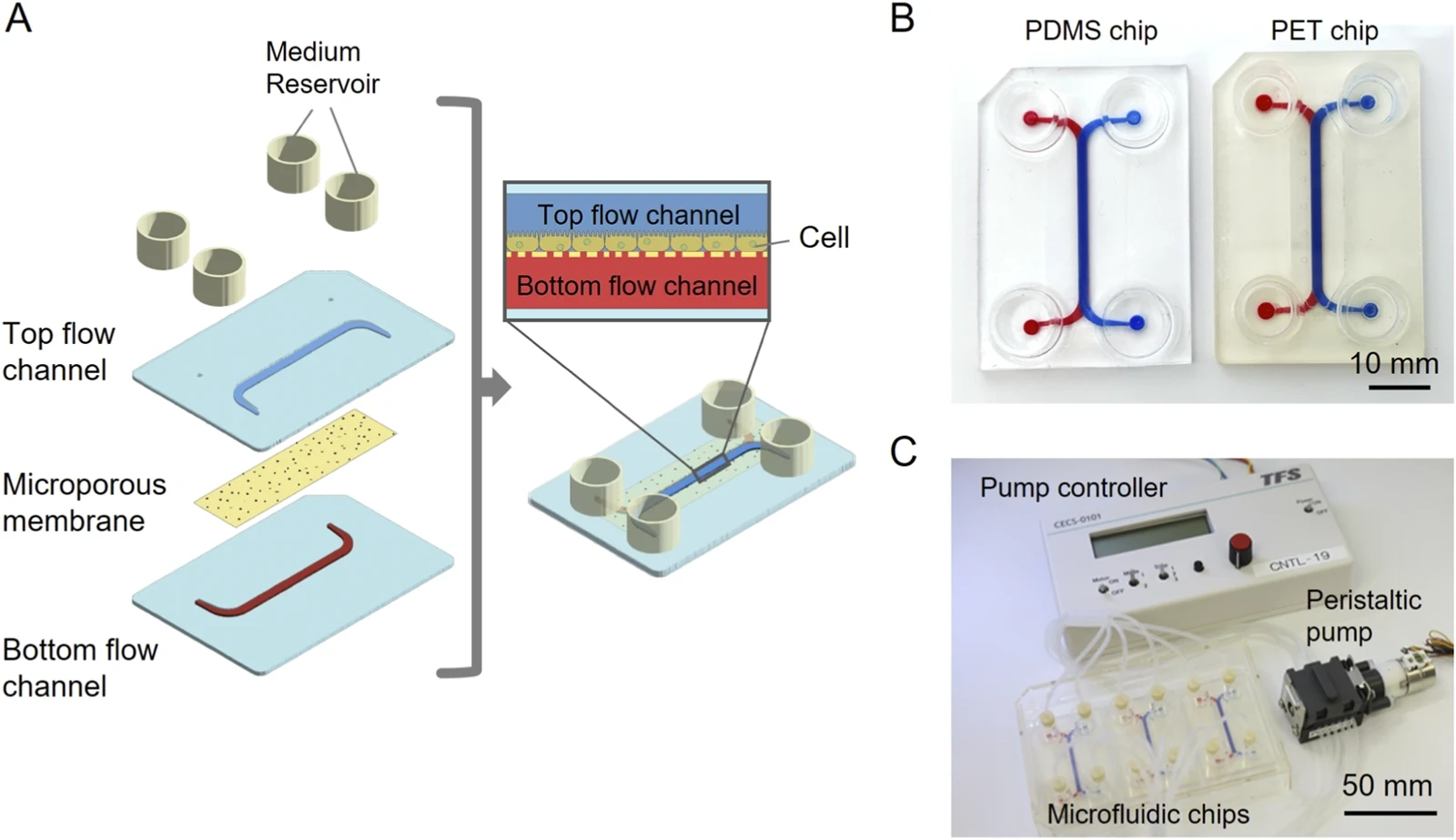
Original Figure 1 shows the two-layer membrane chip design, PET and PDMS devices, and pump-driven perfusion hardware.
Matched-geometry PET and PDMS kidney-chip designs and their perfusion system. (Naokata Kutsuzawa et al. / Frontiers in Toxicology, 2026, Figure 1, CC BY 4.0)

Research Applications

Assessment of culture-environment control and platform-specific pharmacology in renal ischemia–reperfusion modeling.

Model & Design

Human RPTEC/TERT1 proximal-tubule cells in matched PET/PDMS double-layer chips and conventional inserts.

Experimental Format

Glucose-free static low-oxygen interval followed by reoxygenation and restored chip flow; CDDO comparison at the 1% nominal oxygen setting.

Model Components

  • Component

    Culture systems

    Description

    PET/PDMS chips with matched geometry, microporous membranes and insert reference cultures.

  • Component

    Exposure characterization

    Description

    Finite-element oxygen-transport/consumption simulation with morphology and viability observations.

  • Component

    Drug measurements

    Description

    CDDO concentration response, CCK-8 viability and selected insert-derived injury/hypoxia gene markers.

Measurements & Endpoints

  • Predicted cell-surface oxygen
  • Morphology and viability
  • Insert HIF1A/GLUT1/VEGFA/KIM-1
  • CDDO concentration-dependent viability

Analysis

Keep simulated oxygen separate from direct measurements and identify the actual platform used for each biological endpoint.

Published Evidence

  • Study Design

    Compare injury across materials and CDDO responses between inserts and PET chips under the same nominal 1% oxygen condition.

    Study Sample

    One immortalized human proximal-tubule line; at least three independent injury/drug experiments.

    Comparison

    In-air controls, PET/PDMS materials, static inserts and injured cultures without CDDO.

    Finding

    PDMS cultures showed little corresponding injury while PET chips developed marked viability loss. CDDO significantly improved insert viability at 100 nM; PET showed an improving trend up to 1 μM, with higher-concentration toxicity in both systems.

    Interpretation & Limits
    • Oxygen estimates were not validated by direct in-chip sensing.
    • CDDO was evaluated at one oxygen-deprivation setting.
    • Gene-expression results came from inserts; severe PET injury limited RNA harvest.
    • The cell line and limited functional endpoints constrain physiological coverage.

Sources

  1. Material-dependent oxygen transport governs ischemia-reperfusion injury and drug response in a kidney microphysiological system. Frontiers in Toxicology (2026). ↗