
Reactive-Metabolite Profiles in Hepatic Organoids and Human Hepatocytes
Human hepatic organoids formed drug metabolites and thiol conjugates also observed in primary hepatocyte comparisons. The study separately examined direct acetaminophen metabolism, enzyme induction and saxagliptin metabolite profiles.
Comparing Three Human Metabolism Systems
A Korean academic team evaluated human hepatic organoids for identifying reactive drug metabolites. The study compared organoids with human liver microsomes and plateable cryopreserved human hepatocytes, using acetaminophen and saxagliptin as test compounds. It asks whether the organoids can reveal reactive intermediates or their trapped products while retaining broader metabolic pathways.
The organoids were generated from an induced pluripotent stem cell background and an H9 embryonic stem cell background. The enzyme-induction comparisons used three organoid batches and primary hepatocytes from three donors. Those experimental panels are distinct: organoid batches do not represent three independent stem-cell donors.
Ultra-performance liquid chromatography with tandem mass spectrometry identified metabolites using retention and fragmentation information. Microsomal experiments lasted one hour and could include added NADPH and glutathione. The direct acetaminophen and saxagliptin metabolite comparisons in intact cells used 24-hour exposures. These differences are important for interpreting the metabolite profiles.
Acetaminophen Metabolism and an Enzyme-Induction Test
After 24 hours with 50 μM acetaminophen, organoids produced the reactive intermediate NAPQI, an acetaminophen–glutathione conjugate, a glucuronide and a sulfate. Viability did not significantly change under that condition. The organoids therefore supported both formation of the reactive pathway and phase II conjugation in the same culture.
A second experiment used phenacetin, which is converted to acetaminophen through CYP1A2. The investigators first exposed organoids or primary hepatocytes to omeprazole to induce CYP1A2 and then measured downstream metabolite formation. CYP1A2 transcripts and formation of acetaminophen and its glutathione conjugate increased with induction.
Direct NAPQI was not detected in the phenacetin experiments, although its glutathione-associated product was present. The authors suggest rapid trapping as an explanation. This differs from the direct acetaminophen experiment, where NAPQI itself was detected. The comparison demonstrates the value of measuring both reactive intermediates and conjugates without assuming that every route gives an identical observable metabolite pattern.
Saxagliptin Profiles Retain System-Specific Differences
Saxagliptin exposure reduced viability at higher concentrations, with reported IC50 values of 117 μM in organoids and 144 μM in primary hepatocytes. The researchers selected 50 μM for the metabolite comparison. At that concentration, viability was approximately 76% and 84%, respectively, relative to the study references.
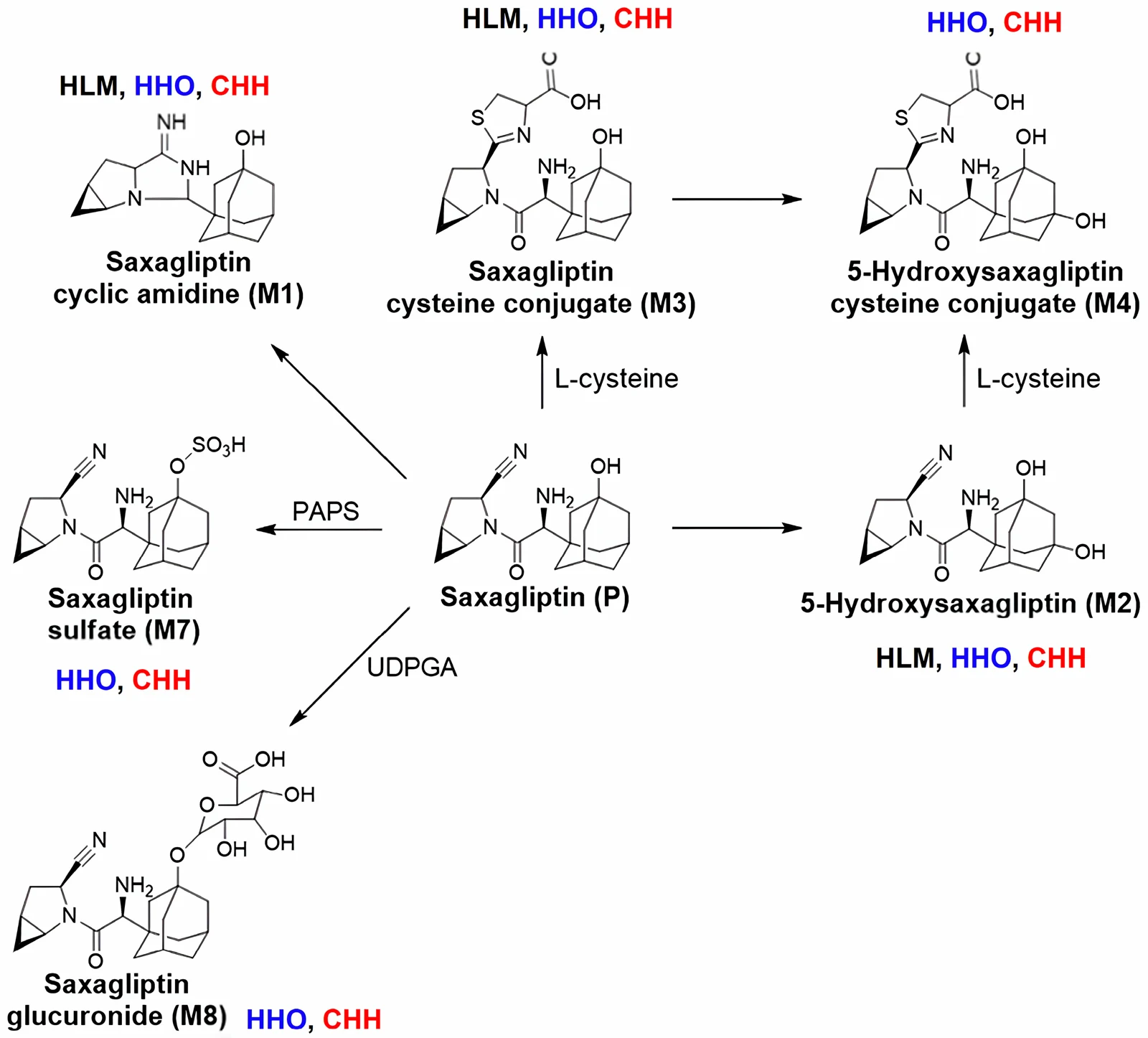
Both cell systems yielded six identified saxagliptin products, including hydroxylation, cyclic-amidine formation, cysteine conjugation, sulfation and glucuronidation products. The distribution of these products differed between systems. Sulfate formation was more prominent in primary hepatocytes, whereas selected cysteine and glucuronide products were more abundant in organoids.
Glutathione conjugates of saxagliptin and its hydroxylated product were not detected in the cell-based experiments. The corresponding cysteine conjugates were identified.
Using Metabolite Identification in Drug Evaluation
The results support organoids as a human-cell setting for following multiple metabolic routes and responses to enzyme modulation. They also show how a longer-lived culture can combine metabolite identification with expression and viability measurements.
Microsomes and intact cells were exposed for different durations and had different cofactor conditions. The authors consequently interpret their cross-system comparison qualitatively. The experiment does not establish equivalent formation rates or identical clearance between microsomes, organoids and primary hepatocytes.
The main evidence is the measured metabolic capability and its change after enzyme induction, together with the specific similarities and differences across the tested human systems. These comparisons support selection of an experimental system for identifying drug metabolites and studying the conditions that change their formation.