
Ovarian Cancer Organoids Link Drug Sensitivity with Chemotherapy and PARP-Inhibitor Outcomes
A single-center study established 21 organoid cultures from 30 untreated ovarian cancers. Chemotherapy comparisons used 12 evaluable cases; selected PARP-inhibitor examples showed agreement with outcomes despite discordance with genomic HRD status.
From Untreated Tumor Tissue to a Drug-Testing Culture
Researchers at Chongqing University Cancer Hospital established patient-derived ovarian cancer organoids to compare functional drug sensitivity with treatment outcomes. The Journal of Translational Medicine study examines chemotherapy and poly(ADP-ribose) polymerase (PARP) inhibitors alongside histological and genomic model characterization. It asks whether a functional assay can add information when a tumor’s genomic profile does not fully explain its treatment response.
The starting cohort comprised 30 newly diagnosed, treatment-naive epithelial ovarian cancers sampled by surgery or biopsy. Organoids were established from 21, a 70% success rate. The successful cultures included high- and low-grade serous, endometrioid and mucinous tumors. The only clear-cell specimen did not produce an organoid because the sampled tissue was predominantly necrotic. The resulting resource therefore did not represent every attempted subtype equally.
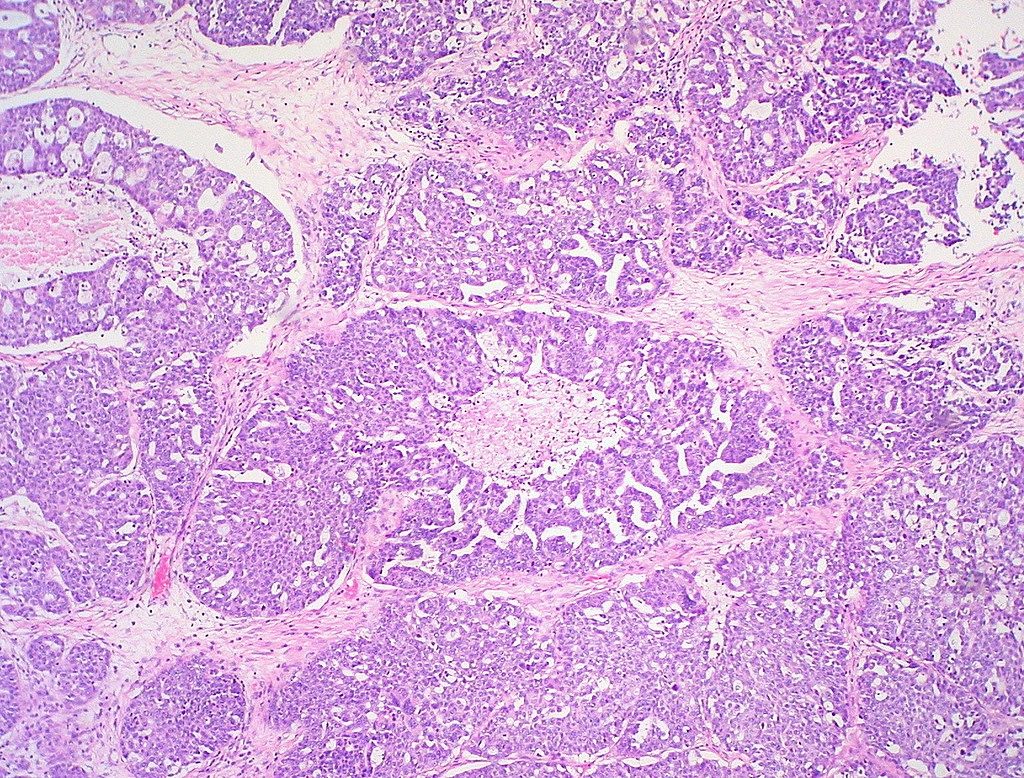
Organoids generally appeared within seven to 10 days and expanded over two to four weeks. Histology and immunostaining supported preservation of subtype-associated morphology and markers. Whole-exome sequencing of 12 matched tumor–organoid pairs found that 78.95% of the reported variants were shared, while tissue-only and organoid-only variants also remained. Model fidelity was substantial but not complete.
The Chemotherapy Comparison Uses a Selected Evaluable Subset
Drug testing used six concentrations, vehicle and positive controls, and an ATP-based viability assay after six days of exposure. Technical triplicates supported dose-response curves and IC50 estimates. The investigators tested carboplatin and paclitaxel sensitivity in organoids from 20 patients who received the corresponding first-line regimen; one patient with an established organoid declined adjuvant chemotherapy.
Clinical comparison was restricted to 12 cases. Eight patients who had satisfactory primary cytoreduction without residual disease and no recurrence within six months were excluded from this analysis because surgery and chemotherapy effects could not be separated. That decision makes the evaluable denominator central to the reported performance.
Across the 12 cases, the assay’s sensitivity was 100% with a 95% confidence interval of 62.88–100%, and specificity was 66.67% with an interval of 12.53–98.23%. Accuracy was 91.67% with an interval of 61.52–99.79%, and area under the receiver operating characteristic curve was 0.95. The broad intervals, especially for specificity, reflect the small number of evaluable outcomes. The performance estimates apply to this selected evaluable subset.
Individual examples included an organoid with high carboplatin IC50 from a patient with platinum-refractory high-grade serous disease and a resistant low-grade serous culture from a patient who developed liver metastasis within six months. These observations support studying functional heterogeneity, while they do not eliminate the selection introduced by culture establishment and clinical evaluability.
PARP-Inhibitor Response Can Differ from Genomic Expectations
The PARP-inhibitor analysis tested olaparib and niraparib in 10 organoids from patients receiving first-line maintenance. Four carried germline BRCA1/2 mutations. One of these, hgsEOC-11, was resistant in vitro despite the expected sensitivity based on homologous-recombination deficiency, or HRD. The corresponding patient relapsed after 15 months of maintenance.
Conversely, a BRCA-wild-type, HRD-negative model, hgsEOC-2, showed in vitro sensitivity. Its source patient remained in complete response during niraparib maintenance at the reported 32-month follow-up. These are illustrative genotype–function discrepancies, rather than proof that organoid testing universally supersedes genomic biomarkers.
The authors classified maintenance benefit using duration criteria drawn from the OReO study: at least 18 months after first-line chemotherapy for BRCA-mutant cases and at least 12 months for BRCA-wild-type cases. That operational definition is part of their clinical comparison. Remission duration after surgery and chemotherapy is not a direct experiment isolating the effect of maintenance therapy.
The study supports evaluating organoids as a functional complement to genomic analysis. Its most useful result is the separation of model establishment, molecular concordance and clinically evaluable drug-response subsets. A larger prospective study would be needed to determine whether the assay improves treatment decisions and whether the reported performance persists across additional patients, histologies and treatment settings.