
T-Cell Subsets Shape Apremilast Responses in Human Skin Equivalents
Full-thickness human skin equivalents developed psoriasis-associated features after addition of defined CD4+ or CD8+ T-cell subsets. Apremilast responses differed by subset and donor, with cytokine-suppression trends in CD4+ cultures failing to reach statistical significance.
Adding Defined Immune Populations to Human Skin
Researchers at Charité – Universitätsmedizin Berlin and Amsterdam UMC incorporated psoriasis-associated T-cell populations into full-thickness human skin equivalents. The model brings an epidermis and fibroblast-populated dermal support together with defined CD4+ and CD8+ subsets, allowing immune composition to be varied during a drug-response comparison.
Keratinocytes and fibroblasts came from healthy juvenile skin, while blood-derived T cells came from healthy volunteers. The investigators compared skin equivalents containing polarized Th1/Th17 cells, Tc1/Tc17 cells or a combination of both groups. T-cell-free tissues provided a reference. The model recreates selected psoriasis-associated interactions using these defined healthy-donor components.
After three days, T cells had entered the dermal compartment toward the epidermis. The skin tissues remained structurally intact, while their cytokine and differentiation patterns changed. IFN-γ, IL-17A and TNF-α were detected in T-cell-containing cultures; IL-1β, CCL20 and IL-6 also increased compared with T-cell-free controls.
Tissue Features Accompany the Inflammatory Signals
The epidermal changes included a reduction in the normal distribution of cytokeratin 10 and uneven, lower loricrin expression. Elafin/SKALP and human β-defensin 2 increased. These measurements connect the inflammatory cell environment with altered keratinocyte differentiation and psoriasis-associated antimicrobial-protein expression.
Handling itself affected the baseline. Moving tissues between inserts increased some inflammatory mediators in T-cell-free cultures. The study therefore included transferred T-cell-free controls as well as a non-transferred reference. This comparison separated a procedure-associated response from the additional effects of immune-cell integration.
Four independent experiments using different skin and T-cell donors showed substantial between-donor variability. Each experimental condition included technical triplicates. Consistent responses within a donor supported the comparison, while differences across donors constrained the statistical interpretation of the pooled drug results.
Apremilast Produces Subset- and Donor-Dependent Patterns
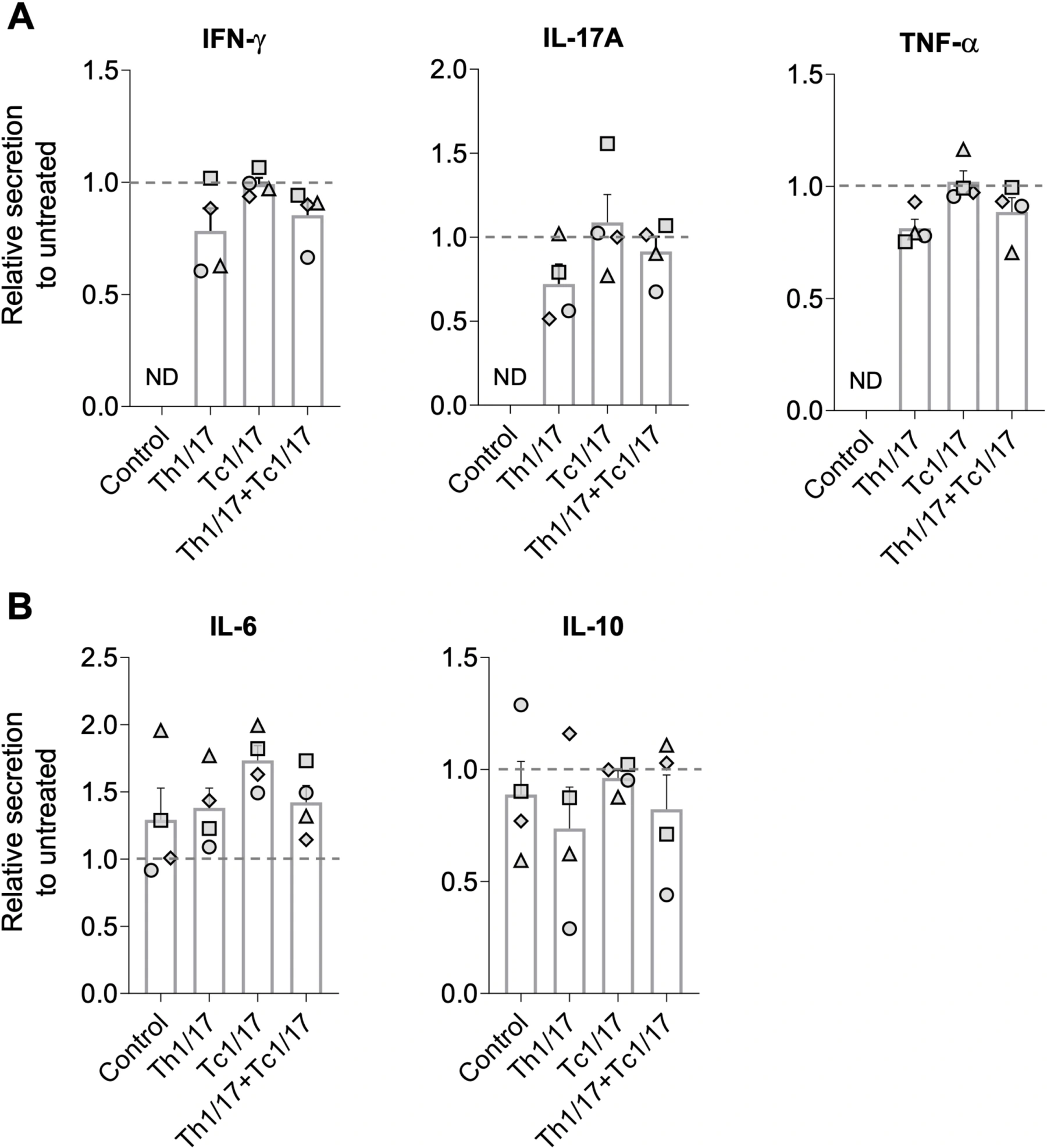
The investigators introduced 2.5 μM apremilast when T cells were added and measured secreted cytokines after three days. Drug-treated cultures were normalized against untreated cultures of the same cell composition. Apremilast inhibits phosphodiesterase 4, providing a clinically relevant anti-inflammatory mechanism for testing the model.
IFN-γ, IL-17A and TNF-α declined in the CD4+ Th1/Th17 setting in at least three of four donors. The corresponding CD8+ Tc1/Tc17 cultures were largely unresponsive. The authors describe the CD4+ cytokine reductions as consistent trends that did not reach statistical significance because of donor variability and the limited sample size.
Other mediators moved differently. IL-6 increased after drug treatment in all T-cell-containing donor cultures, and IL-10 responses varied with donor and T-cell composition. The observed pharmacology is therefore a pattern across several cytokines, rather than a uniform decrease in all inflammatory measurements.
A Setting for Studying Immune Contributions to Drug Response
The model demonstrates how the choice of immune populations changes the information obtained from an anti-inflammatory drug experiment. A skin equivalent containing CD4+ subsets and one containing CD8+ subsets can share psoriasis-associated tissue features while responding differently to the same treatment.
The authors discuss differences in PDE4-related biology as a possible explanation for the subset-specific response. Their experiment does not establish that mechanism directly. It also lacks the full resident immune repertoire, appendages and perfused vasculature of human skin, and its complexity currently limits throughput.
The immediate value is a controlled comparison of tissue and immune-cell contributions, with donor variation retained in the results. Larger donor panels and additional immune populations would extend the pharmacological evidence beyond this initial four-experiment comparison.