
Uveal Melanoma Organoids Retain Epigenetic Features and Respond to HDAC Inhibition
Air–liquid interface cultures preserved patient-specific features of uveal melanoma while showing culture-associated chromatin changes. Quisinostat altered histone acetylation and gene expression, with variable viability responses.
Building a Model from Fresh and Frozen Tumors
Researchers in Germany and Italy established air–liquid interface organoids from uveal melanomas obtained from five patients. The work combined conventional tumor-model characterization with mass-spectrometry analysis of histone posttranslational modifications, allowing the investigators to examine an epigenetic feature that is often less extensively measured in organoid studies.
Fresh material produced cultures from four patients, while cryopreserved tissue produced cultures from all five. Organoids formed over roughly one to two weeks, with growth varying among tumors. Growth increased between weeks 2 and 4, stabilized between weeks 4 and 8, and then declined. Cultures did not survive beyond approximately 11 weeks, and passaging did not produce sustained expansion.
The cultures resembled the corresponding tumors histologically and retained melanoma markers and characteristic genetic variants. Transcriptomic comparisons found broad similarities, with important differences involving immune and vascular signals. Lymphocytes and macrophages were not detected in the organoids at the assessed culture time points, despite variable immune infiltration in the original tissues.
Measuring Histone Features Against the Original Tumor
Four matched tumor–organoid pairs were used for the histone comparison. Mass spectrometry measured common modifications on histones H3 and H4. Patient-specific patterns were broadly retained, while several acetylated histone peptides were lower in the organoids and some repressive methylation marks were higher. Thus, preservation of individual tumor features coexisted with systematic changes associated with culture.
The authors compared these changes with a previously published dataset of uveal melanoma cell lines. Many modifications changed in the same direction relative to tumor tissue, but the changes were generally smaller in the organoids. That comparison supports the use of the cultures for studying epigenetic variation while showing which features require monitoring after the tissue enters culture.
Testing Quisinostat at Several Molecular Levels
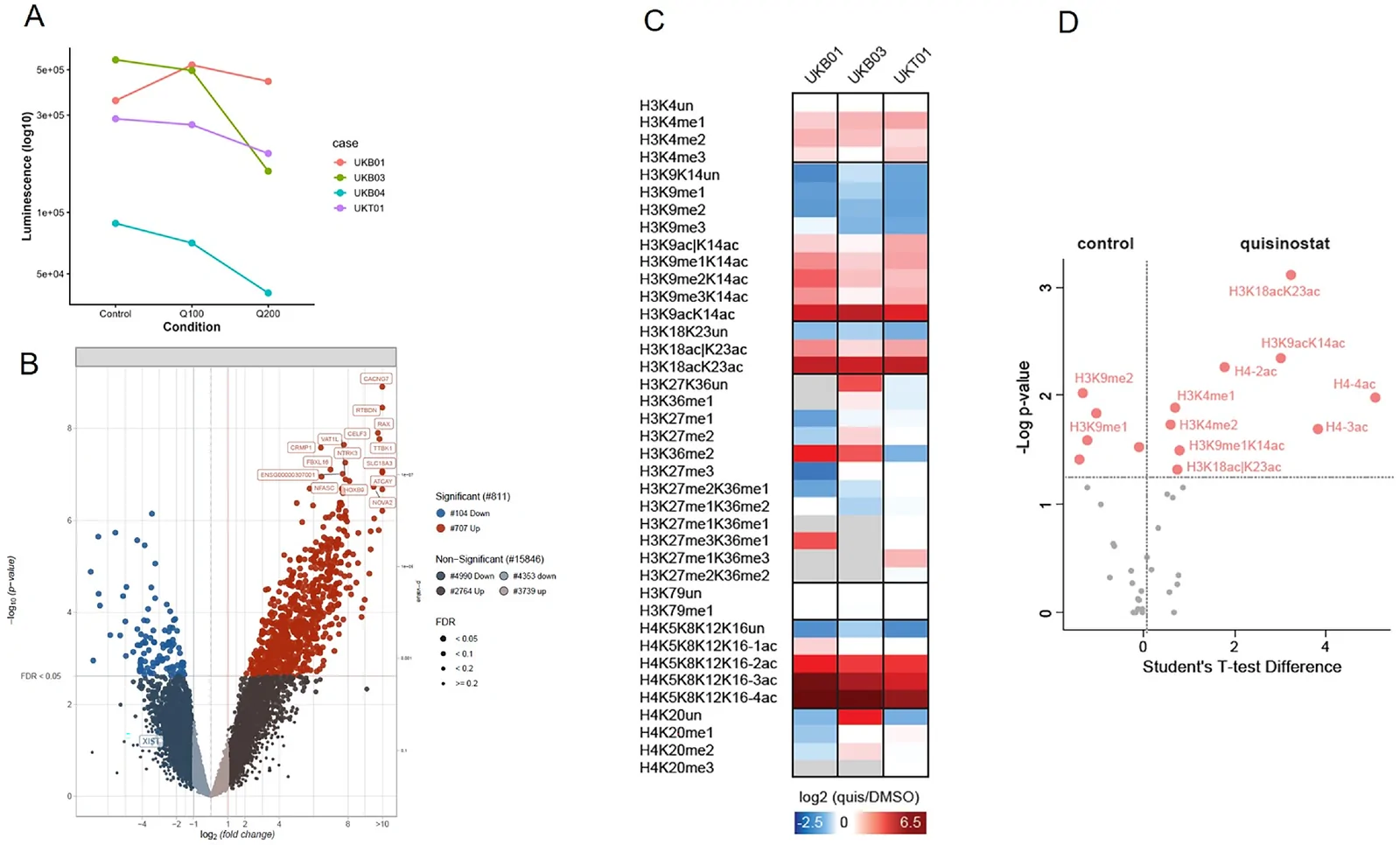
Organoid cultures were exposed to the histone deacetylase inhibitor quisinostat at 100 nM and 200 nM for 72 hours, with matched medium and DMSO controls. Bright-field images showed no substantial morphological difference between treated and untreated cultures. ATP-associated luminescence nevertheless showed variable viability responses across the cultures tested.
RNA profiling of eight organoid samples from two tumors identified 811 differentially expressed genes: 707 increased and 104 decreased at the study's false-discovery-rate threshold. Changes included induction of neural or neuroectodermal programs and lower expression of some proliferation- and melanocytic-identity genes. These measurements described the transcriptional response in the specific subset used for the drug experiment.
Mass spectrometry also showed increases in several H3 and H4 acetylation marks after quisinostat treatment, consistent with histone deacetylase inhibition. The combination of histone, transcript and viability measurements gave the researchers several ways to follow drug response, even when the cultures looked similar by routine bright-field microscopy.
The Experimental Window Shapes Its Uses
The study positions the model for ex vivo investigation of epigenetic therapies and patient-to-patient variation. Its short-lived expansion window limits experiments that require long-term propagation, and the loss of immune and vascular components restricts questions about those parts of the tumor environment. Establishment, matched histone analysis and drug-response experiments also used different sample subsets.