
A Gene-Expression Score Tracks Kidney Identity and Drug Injury in Organoids
KiGEP uses a kidney-focused expression panel to compare organoids with reference tissue. The study combines developmental comparisons with selected drug exposures, including a non-injurious comparator and cisplatin–cimetidine co-treatment.
Scoring Kidney Features across Model Types
Kidney organoids are often characterized with a small number of lineage markers, yet those markers provide limited information about how closely the tissue resembles a human kidney. A team led by Korean public research institutes developed KiGEP, a kidney-specific gene-expression panel and scoring algorithm, to make that comparison more systematic. The study also asks whether loss of kidney-associated expression after drug treatment can complement independent injury measurements.
The investigators analyzed GTEx RNA-sequencing data from 21 organs, covering 7,361 samples, and selected an 86-gene panel enriched for kidney-associated functions. The score compares a sample with specified kidney and low-differentiation reference data using a distance-based calculation. Its percentage scale expresses similarity within that reference framework.
Reference Tissue and Developmental Comparisons
Kidney samples in the construction dataset scored at the kidney end of the scale, while other organs received substantially lower scores. An external comparison using 72 normal kidney samples from The Cancer Genome Atlas produced an average score above 98%. This provided a separate tissue-level check on the panel's ability to recognize the expression features for which it was designed.
In organoids derived from human pluripotent stem cells, KiGEP scores increased from 32.3–35.2% on day 14 to 51.2–55.7% on day 25 and 60.4–64.9% on day 30. Adult-kidney-tissue-derived organoids scored 61.44–76.98%. These study-defined similarity measurements complement morphology and lineage markers when characterizing kidney organoids.
The panel intentionally emphasizes kidney epithelial identity. Vascular and immune-related gene programs were excluded to reduce the influence of those components on the similarity calculation. That design helps define the score's biological meaning: a strong epithelial similarity result leaves other aspects of whole-kidney physiology to be assessed with appropriate functional measurements.
Testing Responses to Selected Drugs
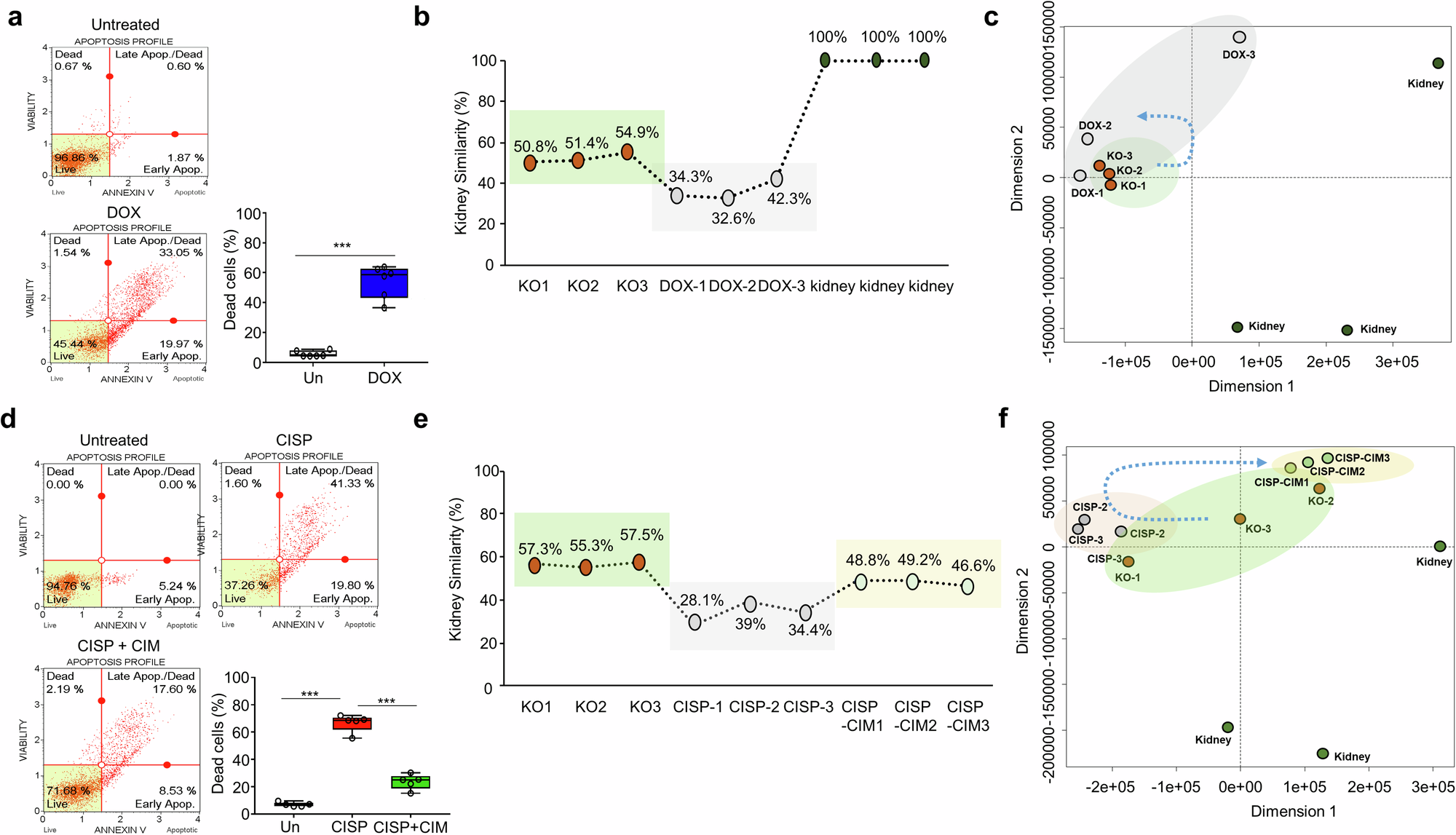
Cisplatin and doxorubicin exposures damaged tubular structures and increased independent indicators of injury. The investigators assessed morphology, renal injury-marker expression and annexin V staining alongside KiGEP. Scores fell after the nephrotoxic treatments, linking a change in kidney-associated expression with the measured cellular response.
Captopril provided a contrasting pharmacological exposure. Under the tested conditions, annexin V measurements showed no significant increase in apoptosis, and the kidney-similarity scores remained close to those of untreated organoids. Reported untreated scores of 62.4% and 64.4% were comparable with 62.9% and 63.0% after captopril. The comparison addresses whether the algorithm responds to any drug exposure indiscriminately.
In a separate experiment, cimetidine attenuated cisplatin-associated apoptosis and partly restored the expression score. Untreated organoids in that experiment scored 55.3–57.5%; cisplatin-treated samples fell to 28.1–39.0%, and the combination reached approximately 46.6–49.2%. These values come from the cisplatin comparison and are interpreted against its own untreated cultures.
Using the Score with Phenotypic Measurements
The study's approach is useful because it relates a transcript-based summary to visible tissue changes and independent injury assays. A score alone compresses many expression measurements into one number. Morphology, apoptosis and injury-marker data help establish what a change in that number corresponds to in the tested cultures.
The drug evaluation covers a small defined set of exposures, including the protective combination. It does not establish broad predictive performance across all mechanisms of renal toxicity. The authors also identify the panel's epithelial focus as a limitation for injury involving immune activation or endothelial dysfunction. Additional modules could extend the biological coverage, but those functions are outside the present score.
For model development, KiGEP offers a reproducible calculation that can be followed across differentiation and selected experimental perturbations. Its most informative use is alongside the culture's actual cellular composition, the reference data used for scoring and the functional endpoints relevant to the drug question.